

What if the heavy financial burden of a dignified goodbye was already covered by the state, leaving you free to focus on your loved one’s memory instead of your bank account? Losing a family member is an exhausting experience, and it's natural to feel a sense of panic when faced with the high costs of funeral services in the Denver metro area. Many families in Aurora find themselves asking, does medicaid pay for cremation, especially when they fear being turned away by providers during their deepest moment of grief.
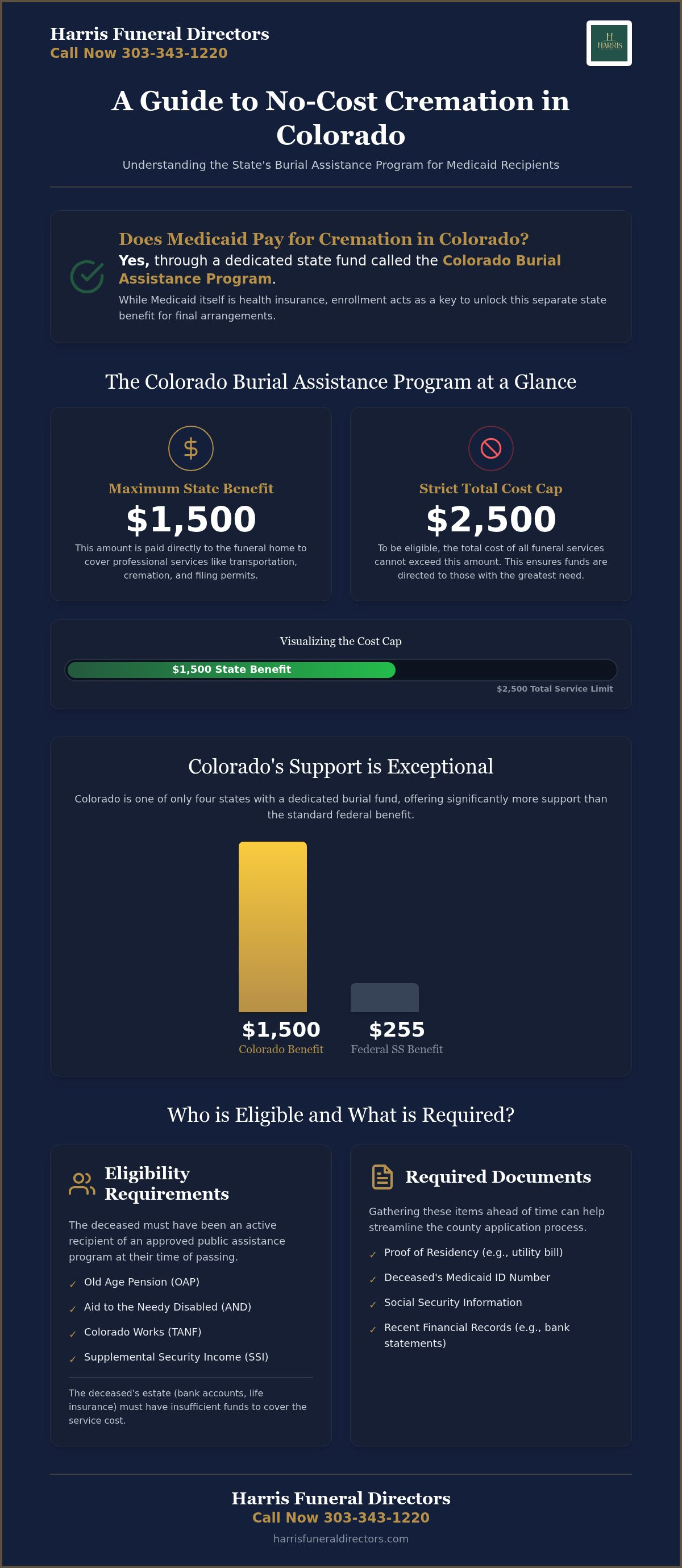
We understand the confusion that comes with government paperwork and the need for clear, honest answers. The good news is that Colorado offers a path to a respectful, no-cost cremation for those who qualify. In 2026, the state's Burial Assistance Program provides up to $1,500 toward these costs for individuals who were receiving Medicaid or other public assistance at the time of their passing. This guide will walk you through the specific eligibility requirements, the strict $2,500 total cost cap, and how a local Aurora partner can manage the complex application process on your behalf. You deserve a steady hand to guide you through these practical steps so you can find peace and closure.
Does Medicaid Pay for Cremation in Colorado?
When a loved one passes away, the immediate concern for many families is how to provide a dignified farewell without facing financial ruin. You might find yourself asking, does medicaid pay for cremation as you look for ways to honor your family member's legacy. In Colorado, the answer is a reassuring yes, though the process is handled through a specific state-funded resource known as the Colorado Burial Assistance Program. This benefit is designed specifically for eligible residents who were enrolled in public assistance programs at the time of their passing.
It's helpful to distinguish between different types of government support during this time. While Medicaid functions primarily as health insurance to cover medical needs during life, it doesn't directly pay for funeral costs. Instead, your loved one's enrollment in Medicaid acts as a key to unlock the Burial Assistance Program. This state-managed fund ensures that financial limitations don't prevent a family from choosing a respectful cremation service. It serves as a compassionate bridge for those who have spent their lives contributing to our community but left behind limited estates.
The 2026 Colorado Burial Assistance Program
For the 2026 calendar year, the state of Colorado has set a maximum benefit of $1,500 to assist with final arrangements. These funds are specifically allocated to cover the "professional services" provided by a funeral home. This typically includes the transportation of your loved one into our care, the cremation process, and the filing of essential legal permits. You can view a full list of what these services overview entails to better understand the support available. For families in Aurora and the wider Denver metro area, this program is a vital lifeline. It's important to remember that the total cost of the services cannot exceed $2,500 to remain eligible for this help. This cap is strictly enforced by the state to ensure the funds reach those with the most significant financial need.
How the Benefit Differs from Other States
Colorado is one of only four states in the country that maintains such a dedicated and robust burial fund for its residents. While most Americans only have access to the federal Social Security death benefit, which is currently a one-time payment of $255, Colorado residents have much stronger support. This state-level assistance is paid directly to the service provider rather than the family. This ensures that the funeral home can begin their work immediately without asking you for a large upfront deposit. Because each county manages its own applications, working with a local partner who understands the specific requirements of the Aurora human services department is essential. We act as your advocate, managing the complex paperwork so you can focus on your family's emotional healing instead of government bureaucracy.
Eligibility Requirements for Medicaid-Funded Cremation
Understanding the rules for state assistance can feel like a full-time job when you're already exhausted by grief. While you're asking does medicaid pay for cremation, it's vital to know that eligibility is determined by the County Department of Human Services. They look at the specific financial situation of the deceased at the time of their passing. If your loved one lived in Aurora or Denver, we'll work with the respective county office to verify their status. The state essentially steps in when a person’s estate and their legally responsible relatives don't have the resources to cover the final expenses.
The criteria for this assistance are quite specific. According to the official guidelines for Colorado's Burial Assistance Program, the deceased must have been a recipient of an approved public assistance program. This isn't a general benefit for everyone with a low income; it's tied directly to active enrollment in programs like Medicaid or the Old Age Pension. Because the state manages these funds at the county level, the approval process relies heavily on local verification. We act as your steady partner during this phase, helping you understand which assets count toward the limit and which do not.
Qualifying Medicaid Categories in Colorado
To receive this help, the decedent must have been enrolled in programs such as the Old Age Pension (OAP), Aid to the Needy Disabled (AND), or Colorado Works (TANF). Many families we serve are also recipients of Supplemental Security Income (SSI). Eligibility is verified through the specific county where the decedent resided at the time of death. This means an Aurora resident's application will be processed by either Arapahoe or Adams County, depending on their exact street address. Knowing this helps us route the paperwork to the right desk immediately.
Documentation You Will Need to Provide
Gathering paperwork is often the hardest part of the process when your mind is elsewhere. You'll need to provide proof of residency, the deceased's Medicaid identification number, and their Social Security information. Financial records, including recent bank statements or proof of limited assets, are also required. If your loved one is currently in hospice, you might find it helpful to plan ahead by gathering these documents now to avoid a rush later. This preparation ensures that the transition into our care is seamless and the county application moves forward without delay.
Asset limits are a major factor in the final decision. The state reviews any remaining funds in bank accounts or life insurance policies. If these assets exceed the cost of the service, or if the total cost of the cremation exceeds $2,500, the application might be denied. We help you navigate these limits to ensure your family remains eligible for the maximum $1,500 benefit. It's our goal to ensure you never have to wonder does medicaid pay for cremation while also worrying about being turned away due to a lack of funds.
How the Medicaid No-Cost Cremation Process Works
The process of securing state assistance shouldn't feel like a burden you carry alone during a time of loss. When you ask, does medicaid pay for cremation, it's important to understand that the state of Colorado doesn't send a check to the family. Instead, the funds are paid directly to the funeral home or cremation provider you choose. This system ensures that the money is used specifically for the intended services and helps simplify the financial side of your arrangements. Most families find that approval happens quickly, often within just a few business days after the initial application is submitted to the county office.
A critical detail to remember is that you should not pay for the services out of pocket before the claim is filed. The Colorado Burial Assistance Program is not designed as a reimbursement for bills already settled. If you pay the full amount upfront, the state will likely deny the application for assistance. By contacting us immediately, we can start the paperwork before any financial commitments are made. This protects your eligibility and ensures that the state's contribution is applied correctly to the final balance. It's our job to handle these logistics so you can focus on saying goodbye.
The Role of the Funeral Director
Our team serves as a dedicated liaison between your family and the Colorado Department of Human Services. We handle the heavy lifting of the bureaucracy, including the submission of State Form 35937, which is the official application for burial or cremation assistance. We verify the decedent's status and ensure every requirement is met to avoid delays. You can learn more about our compassionate funeral directors and how we advocate for Aurora families. We've spent years building relationships with county officials, which allows us to guide you through the process with confidence and clarity. We believe that every resident deserves a steady partner to navigate these complex state requirements.
What Happens if the Benefit Doesn’t Cover Everything?
The standard service covered by state assistance is known as a direct cremation. This includes the essential professional services, the cremation process itself, and a simple container for the remains. Because the state limits the total cost of the service to $2,500, we work carefully to stay within those bounds while maintaining the highest level of dignity. Families often choose to view our transparent pricing and packages to see how they can personalize the arrangements. If your family wishes to add a memorial service or choose a specific keepsake urn, we can discuss how those choices fit within the state's financial guidelines. Our priority is ensuring that the final tribute is both respectful and affordable.
Arranging Service in Aurora: Step-by-Step Guidance
When a death occurs, the world seems to stop, but the timeline for state assistance begins immediately. Taking the right steps in the first few hours can make the difference between a smooth approval and a stressful denial of benefits. If you're wondering does medicaid pay for cremation, the most important thing you can do is reach out to a provider who understands the Aurora and Denver metro area requirements. We've simplified the process into four clear steps to help you find your footing during this difficult time.
To ensure your family receives the full support available, follow this methodical path:
- Step 1: Notify the funeral home immediately. You should call us as soon as the passing occurs, whether it happens at home, in a hospital, or at a care facility.
- Step 2: Provide the Medicaid ID and county of residence. Have your loved one’s identification number and proof of their Aurora or Denver address ready so we can start the verification.
- Step 3: Sign the required authorization forms. The state requires specific signatures to release funds and authorize the cremation process. We'll guide you through these documents with patience.
- Step 4: Eligibility verification and service. We work directly with the county to confirm the benefit and then proceed with the cremation according to your wishes.
Immediate Need in the Denver Metro Area
For families currently facing a loss in Aurora, Thornton, or surrounding neighborhoods, the "first call" is the most critical moment. It's vital to mention the deceased's Medicaid status during this initial conversation. This allows us to pause any billing and immediately contact the local Department of Human Services to secure the $1,500 state benefit. If you are in this situation right now, our Immediate Need guide for families provides a steady checklist of what to do next. We're here to act as your advocate, ensuring that no family is turned away because of financial constraints during their hour of need.
Planning Ahead for Medicaid Recipients
If your loved one is currently in hospice or long-term care, you can ease the future burden on your family by starting the conversation today. Pre-planning is an act of love that prevents confusion during grief. For those with a small amount of remaining assets, setting up an irrevocable funeral trust can be a wise choice. This legal tool allows you to set aside funds for final expenses that Medicaid cannot "spend down" or count against eligibility limits. You can start your pre-planning journey here to gain peace of mind. Taking these small steps now ensures that when the time comes, the question of does medicaid pay for cremation is already answered and the path forward is clear.
If you need help determining if your loved one qualifies for these benefits, please reach out to our team at Harris Funeral Directors for a quiet, respectful consultation.
Why Families Choose Harris Funeral Directors for Medicaid Assistance
Choosing a partner to handle your loved one’s final arrangements is a deeply personal decision, especially when you are navigating the complexities of state assistance. At Harris Funeral Directors, we believe that every family deserves a dignified farewell, regardless of their financial circumstances. When families ask does medicaid pay for cremation, they aren't just looking for a technical answer; they are looking for a steady hand to guide them through a difficult time. As a family-owned and operated business in Aurora, we take personal accountability for every service we provide. We don't view our clients as cases to be processed, but as neighbors who deserve our full attention and respect.
Our team acts as a "Compassionate Guide" to remove the administrative burden from your shoulders. We have deep experience navigating the Colorado state burial assistance system and the specific requirements of local county offices. This expertise allows us to manage the paperwork efficiently, ensuring that your family receives the maximum benefit available without unnecessary delays. We understand that the fear of being turned away due to a lack of funds is a heavy weight to carry. By stepping in as your advocate, we provide the stability and reliability you need to focus on your emotional healing.
A Legacy of Service in Aurora and Denver
Our commitment to the community extends across the entire Denver metro area, including Commerce City, Arvada, and Thornton. We've built our reputation on a foundation of transparency and honesty, values that are particularly important when discussing state-funded services. We believe that clarity in pricing is a core part of providing high-quality care. If you are looking for more information on how we structure our services to remain accessible, you can read our guide on Affordable Funeral Packages in Aurora. This transparency ensures that you can make informed decisions without the pressure of hidden costs or complicated industry jargon.
Beyond the Cremation: Grief Support and Resources
The journey of loss doesn't end once the cremation is complete, and neither does our care for your family. We provide access to a variety of local resources to help you navigate the transition into life after loss. Whether you need help with the practical aspects of settling an estate or you're seeking emotional support, we are here to help. You can explore our grief support materials to find guidance that speaks to your specific needs. It's important to us that you feel supported long after the final arrangements are settled. Our commitment to your family remains steady, and our support doesn’t end when the service is over.
Finding Peace and Support for Your Family
You don't have to navigate the weight of loss and the complexity of state paperwork alone. We've explored how Colorado’s state-funded programs provide a dignified path forward, ensuring that financial barriers don't stand in the way of a respectful goodbye. By understanding the eligibility requirements and the specific $1,500 benefit available in 2026, you can make informed decisions that honor your loved one’s legacy without added stress. While you may have started this journey asking does medicaid pay for cremation, we hope you now feel empowered with clear answers and a local partner ready to help.
As a family-owned business in Aurora with an A+ rating for compassionate care, we specialize in Medicaid No-Cost Cremation. We're here to act as your advocate, managing every state form and requirement so you can focus on your family's needs. If you have an immediate need or simply want to learn more about your options, please Contact Harris Funeral Directors for Medicaid Assistance. You aren't just a case to us; you're our neighbor, and we're honored to walk alongside you during this time.
Frequently Asked Questions
How much does Colorado Medicaid pay for cremation in 2026?
The Colorado Burial Assistance Program provides a maximum benefit of $1,500 for cremation or burial services in 2026. This state-funded resource is paid directly to the service provider rather than the family. To remain eligible for this help, the total cost of all funeral or cremation services and merchandise cannot exceed $2,500. We help you manage these limits to ensure the state's contribution covers as much as possible.
Can I still get help if my loved one had a small life insurance policy?
Yes, you can still apply for assistance, but the state will consider the life insurance policy as an available asset. Any funds from the deceased's estate or insurance are typically applied to the bill first. If those resources don't cover the full cost, the Burial Assistance Program may provide the remaining balance up to the $1,500 limit. The total service cost must still stay under the strict $2,500 state cap.
Does Medicaid pay for a burial plot or just the cremation?
The state benefit is flexible and can be applied to either burial or cremation costs, including cemetery fees for a plot. While many families ask does medicaid pay for cremation, the funds can also cover the opening and closing of a grave. However, because the total cost of all services must stay under $2,500, many families find that direct cremation is the most effective way to stay within these financial boundaries.
What if the deceased lived in Denver but passed away in Aurora?
Eligibility for the program is based on the county where the deceased resided at the time of their passing. If your loved one was a resident of Denver but passed away in an Aurora hospital, the application must be processed through the Denver County Department of Human Services. Our team is experienced in working with various county offices across the Denver metro area to ensure your paperwork is filed in the correct jurisdiction.
Is there a deadline to apply for Colorado burial assistance?
You should contact a provider and start the application immediately, as the state will not reimburse a family for a bill that has already been paid. Colorado requirements state that the provider must file the claim before the services are finalized. By reaching out to us as soon as a death occurs, we can secure the benefit and ensure you don't lose eligibility by paying for the service out of pocket first.
Can I choose any funeral home in Colorado for Medicaid cremation?
You may choose any provider that is willing to work with the state's payment system and can keep the total service cost under $2,500. Not every funeral home is familiar with the specific county application process or the 2026 benefit limits. We specialize in providing does medicaid pay for cremation answers and managing the entire process for Aurora families. Our established relationships with county departments help avoid unnecessary delays or denials.
What is the difference between Medicaid burial assistance and the Social Security death benefit?
The Colorado Burial Assistance Program is a state-level resource providing up to $1,500, whereas the Social Security death benefit is a federal one-time payment of $255. The state benefit is paid directly to the funeral home to cover professional services. The Social Security benefit is usually paid to a surviving spouse or child. In some cases, these two benefits can be used together to help manage the final expenses for your loved one.
Will my family have to pay anything at all for a direct cremation?
If your loved one qualifies for the maximum $1,500 benefit and the total cost of the direct cremation stays within that amount, your family may face no out of pocket costs. This is often referred to as a no-cost cremation. If you decide to add optional items like a memorial service, an upgraded urn, or extra death certificates, those additional costs will be the responsibility of the family and must still fit within the $2,500 cap.


