

What if the most dignified way to honor your loved one's legacy didn't have to cost your family a single penny? You might feel overwhelmed by the sudden weight of funeral costs while trying to process your grief. It's completely natural to worry that a limited budget might mean a less respectful service, but that isn't the case here in Colorado. By utilizing Medicaid Burial and cremation assistance, you can ensure a professional farewell that honors your loved one without the burden of out-of-pocket expenses.
We understand that government eligibility rules can feel confusing and hidden costs often create unnecessary anxiety. This guide will show you exactly how to access the Colorado Burial Assistance Program to secure a professional service. You'll learn about the specific requirements for 2026, including the $1,500 state grant and the total service cost cap. We'll also explain how a dedicated funeral director can step in to handle the complex paperwork on your behalf, allowing you to focus on what truly matters; saying goodbye with peace of mind.
What is Medicaid Burial and Cremation Assistance in Colorado?
When you lose someone you love, your focus should be on their memory and your family's healing. Medicaid Burial and cremation assistance is a state-funded benefit designed to ensure that financial limitations never stand in the way of a dignified farewell. This program isn't a form of "charity" in the traditional sense; it's an earned benefit for individuals who were enrolled in the Medicaid program or other specific state assistance plans at the time of their passing. It exists because Colorado recognizes that every resident deserves to be honored with respect and professionalism, regardless of their bank balance.
In our local communities of Denver and Aurora, this assistance often covers the entire cost of a cremation service. This means your family can secure a professional farewell with zero out-of-pocket expenses. You don't have to handle the complex state bureaucracy alone. A compassionate funeral director acts as your advocate and intermediary, coordinating directly with state and county officials to secure these funds. They manage the logistics and the paperwork, allowing you the space to grieve without the weight of administrative burdens.
The Difference Between Burial and Cremation Assistance
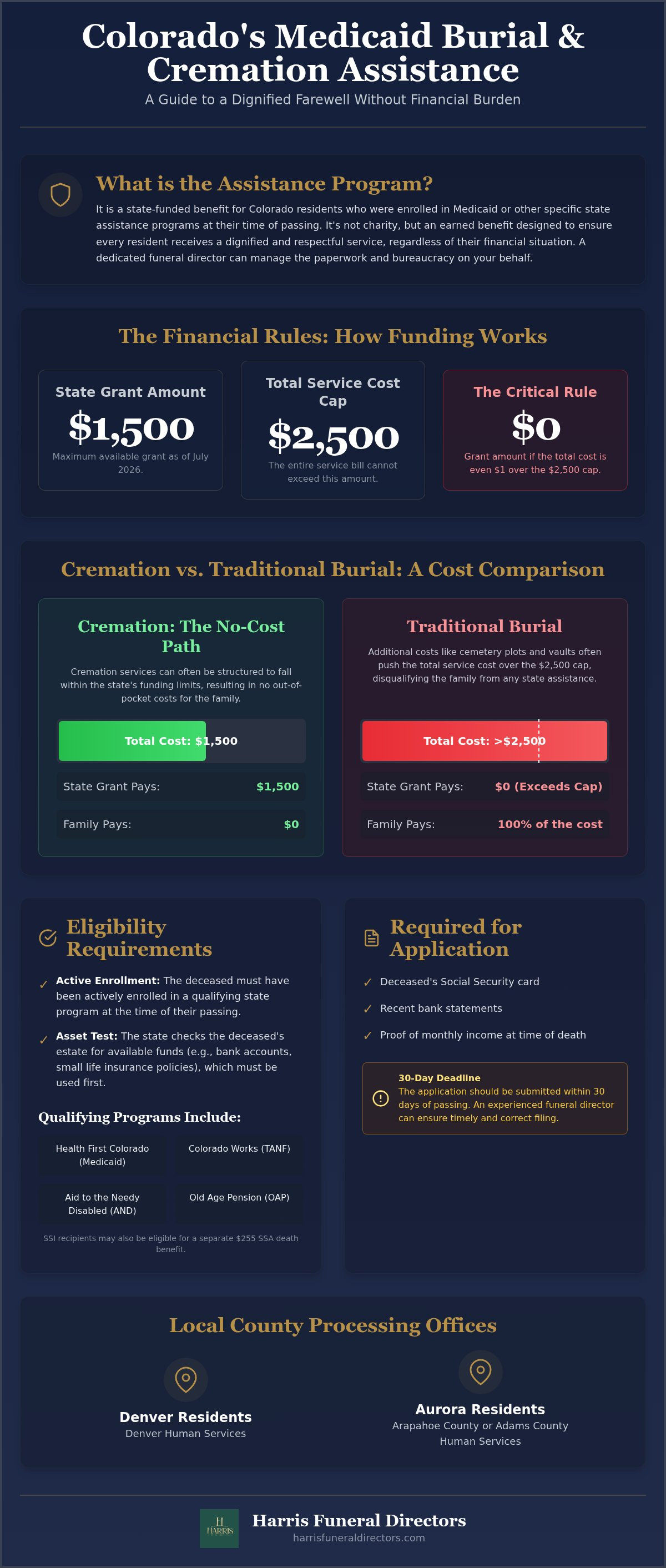
While the state provides support for both options, the way funds are allocated makes a significant difference for your family's budget. As of July 2026, the Colorado Burial Assistance Program offers a maximum grant of $1,500. However, there's a strict rule: the total cost of the entire service cannot exceed $2,500. If the total bill is even one dollar over that cap, the state won't provide any funding at all. Because traditional burial involves additional costs like cemetery plots and vaults, it often exceeds this limit. This is why many families choose cremation services as the most reliable "no-cost" path, as it's easier to keep the total professional fee within the state's required threshold.
Who Manages These Benefits in Aurora and Denver?
The Colorado Department of Human Services (CDHS) oversees the program at the state level, but the actual processing of claims happens in local county offices. If your loved one lived in Denver, the application goes through Denver Human Services at their Federal Boulevard location. For those in Aurora, the claim is typically handled by Arapahoe County or Adams County, depending on the specific residence. Choosing a funeral home that's intimately familiar with these local offices is vital. An experienced partner knows exactly what documentation is required and can ensure the application is submitted within the necessary 30-day window, preventing delays or denials that could cause extra stress for your family.
Eligibility: Does Your Loved One Qualify for Medicaid Assistance?
Understanding who qualifies for financial support is often the first step toward finding peace during a difficult time. In Colorado, eligibility for Medicaid Burial and cremation assistance is strictly tied to the deceased person's status at the exact time of their passing. This benefit is reserved for individuals who were already enrolled in and receiving benefits from an approved state program. It's a common misconception that a family can apply for Medicaid benefits after a death has occurred to cover funeral costs. If the loved one was not actively receiving assistance, the state program typically cannot provide funding.
The state also performs what is often called an asset test. This means they look at the estate of the deceased to see if there are available funds to cover the costs. If your loved one had a small life insurance policy or money in a bank account, those funds must be used first. The state's contribution is designed to fill the gap, ensuring a dignified service is possible even when personal resources are exhausted. If you're feeling uncertain about how your loved one's specific situation fits these rules, you can review our services overview to see how we help families coordinate these delicate details.
Qualifying Programs in Colorado
Colorado uses specific criteria to determine who can access Colorado's Burial Assistance Program. Beyond standard Health First Colorado (Medicaid) enrollment, individuals receiving Colorado Works (TANF) or Aid to the Needy Disabled (AND) are typically eligible. For 2026, the grant standard for the AND Colorado Supplement is $994. Those receiving the Old Age Pension (OAP), which has a 2026 grant standard of $1,032, also qualify for this support. Additionally, individuals receiving SSI may be eligible for a one-time $255 death benefit from the Social Security Administration to help with final expenses.
Documentation You Will Need to Provide
Gathering paperwork while you are grieving is a heavy task. To file a claim successfully, you will generally need to provide the deceased's Social Security card, recent bank statements, and proof of their monthly income at the time of death. Because the application should be submitted within 30 days of the passing, having these records ready allows your funeral director to act quickly on your behalf. If you cannot find the necessary paperwork, don't panic. A dedicated partner can often help you identify alternative ways to verify eligibility through state databases, taking that administrative weight off your shoulders so you can focus on your family.
Medicaid Cremation vs. Traditional Burial: Comparing Your Options
Deciding on the right way to say goodbye involves balancing emotional needs with practical realities. It's often a choice guided by religious traditions, family legacy, or the specific wishes of the person who has passed. When you are utilizing Medicaid Burial and cremation assistance, it's helpful to understand how the state's financial support applies to these different paths. While the state provides a benefit for both, the logistical reality often means one option is more financially accessible for families with limited resources.
At Harris Funeral Directors, we believe every person deserves a respectful farewell. We provide the same high standard of care to every family we serve, regardless of how the service is funded. Choosing a state-assisted option doesn't mean sacrificing dignity or professional attention. Our team ensures that your loved one is treated with the utmost sincerity and solemnity throughout the entire process. We act as your steady partner, helping you choose the path that best honors your loved one's memory within the program's framework.
Understanding Medicaid No-Cost Cremation in Aurora
For many families in Denver and Aurora, cremation is the most practical choice because it can often be completed at no cost to the survivors. When a service stays within the Colorado Burial Assistance Program guidelines, the state's contribution can cover the essential elements. This typically includes the professional services of the funeral director, transportation of your loved one, the cremation process itself, and a simple urn. It's a simple, dignified, and debt-free option that allows you to focus on remembrance. If you want to learn more about this path, you can read our guide on Medicaid Cremation in Aurora.
Assistance for Traditional Burial Services
Traditional burial remains a cherished option for many, though it often involves more complex financial planning. The state grant can be applied toward the purchase of a casket, a vault, or the graveside service. However, there's a "gap" reality to consider. Because the total cost of a burial service frequently exceeds the state’s $2,500 limit for eligibility, families may find that they need to supplement the costs or that the grant is unavailable. This usually occurs because cemetery fees and plot costs are separate from funeral home charges. For a full view of these arrangements, see our guide on Traditional Burial Services in Aurora.
Step-by-Step: How to Arrange Medicaid-Assisted Services
The path to securing benefits begins with a single phone call. When a death occurs, your first step is to contact a funeral home that is deeply familiar with Colorado's specific state requirements. We understand that this moment is heavy with emotion, so we focus on providing a steady hand to guide you through the logistics. By choosing a partner like Harris Funeral Directors, you ensure that the process is handled with professional solemnity from the very start. We immediately begin the work of verifying your loved one's status to confirm that Medicaid Burial and cremation assistance is an available path for your family.
During our initial consultation, we'll sit down together to review your options and select the service that best honors your loved one's memory. This is where we carefully manage the financial details to protect your eligibility. Because the state of Colorado requires the total service cost to remain at or below $2,500 to qualify for the $1,500 grant, we help you select a package that fits these strict criteria. We handle the submission of the official state application for burial assistance, ensuring every detail is accurate to prevent delays. You don't have to worry about the complex bureaucracy during your time of grief; we manage the filing on your behalf.
The timeline for these services is often dictated by the state's processing requirements. Applications must generally be submitted within 30 days of the death, making quick action essential. Once the paperwork is filed, we coordinate with the county to secure approval. While the state's review can take some time, our experience allows us to move forward with the arrangements, providing your family with the closure you need without unnecessary waiting periods.
Contacting the County DHS Office
In some cases, you may need to speak directly with a caseworker at Denver Human Services or the Arapahoe County Department of Human Services. This usually happens if there are questions regarding "Categorical Eligibility," such as confirming a loved one's active status in the Old Age Pension or Aid to the Needy Disabled programs. It's important to understand that the state pays the funeral home directly; the family never receives these funds as a reimbursement. If you need help starting this process immediately, please reach out to us through our immediate need page for urgent support.
Finalizing the Arrangements
Once eligibility is confirmed, we'll help you finalize the necessary authorizations. This includes signing the legal permits for cremation or burial and gathering information for the death certificate. We also assist with obituary notifications to ensure your loved one's life is properly honored within the community. Our goal is to handle every administrative detail, from state filings to local permits, so you can focus entirely on the emotional needs of your family. If you're ready to begin these arrangements, you can contact Harris Funeral Directors to speak with a compassionate advocate today.
Why Choose Harris Funeral Directors for Medicaid Assistance
At Harris Funeral Directors, we view our role as more than just a service provider; we are neighbors caring for neighbors. We believe that every family in Aurora and Denver deserves to be treated with the same kindness and respect, regardless of their financial circumstances. Our commitment to the community is rooted in the belief that a dignified farewell is a fundamental right. When you walk through our doors, you aren't just another case file. You are a grieving family in need of a steady hand and a compassionate heart.
Navigating the requirements for Medicaid Burial and cremation assistance can feel like a daunting task during a time of loss. Our team has spent years mastering the specific nuances of Colorado's state-funded programs. We take that burden off your shoulders by managing the complex state and county paperwork, ensuring all applications are filed correctly and within the required 30-day window. This expertise allows you to step back from the bureaucracy and focus entirely on your own healing and remembrance.
We also prioritize transparent communication throughout the entire process. You will never have to worry about hidden fees or unexpected costs when working with us. We provide a clear, honest explanation of how the state’s $1,500 grant applies to your arrangements and how we keep the total service within the $2,500 eligibility cap. Our goal is to provide you with absolute peace of mind, knowing that your loved one is receiving professional, high-quality care at no cost to your family.
A Legacy of Compassionate Care in Aurora
As a family-owned, independent funeral home, we take great pride in our independence. This allows us to focus on people rather than corporate profit margins. Our "Trusted Family Advocate" approach means we walk alongside you as a steady partner, offering guidance that is both professional and deeply personal. We invite you to learn more about us and our history of serving the Denver and Aurora communities with integrity and sincere care.
Support Beyond the Service
Our dedication to your family doesn't end when the service is over. We understand that the journey through grief is long and often difficult, which is why we provide a variety of grief resources to help you find support in the weeks and months ahead. Whether you need help finding a local support group or simply need reading materials to help process your loss, we are here for you. If you're ready to discuss your options, please contact us today for a quiet, respectful conversation about how we can help your family.
Secure a Dignified Farewell for Your Loved One
Honoring a life shouldn't be defined by the balance in a bank account. Colorado's state benefits provide a clear path to a respectful service without placing a financial burden on your family. By understanding the eligibility rules and choosing a path like no-cost cremation, you can ensure your loved one is treated with the highest level of professionalism and care. The key is acting quickly and partnering with an expert who understands the specific local requirements in Denver and Aurora.
Harris Funeral Directors is a family-owned and operated firm in Aurora. We take our role as a trusted Arapahoe County service provider seriously. We specialize in Medicaid Burial and cremation assistance, taking the administrative weight off your shoulders so you can focus on your family's needs. We are here to answer your questions with transparency and sincerity at every step of the journey.
If you are ready to discuss your options, contact Harris Funeral Directors for a compassionate consultation regarding Medicaid assistance. We are ready to walk beside you with the patience and respect you deserve during this difficult time.
Frequently Asked Questions
Does Medicaid pay for the entire cost of a funeral in Colorado?
Medicaid can cover the entire cost of specific services, such as a simple cremation, provided the total bill stays within strict state limits. The Colorado Burial Assistance Program provides a maximum grant of $1,500 toward final expenses. However, this grant is only available if the total cost of the funeral or cremation does not exceed $2,500. If the service cost goes over this cap, the state will not provide any financial support.
What happens if my loved one was not on Medicaid but had no assets?
Eligibility for this specific grant is categorical, meaning the deceased must have been receiving benefits from an approved program at the time of death. These programs include Health First Colorado, Old Age Pension, or Aid to the Needy Disabled. If your loved one was not enrolled in one of these programs, they typically won't qualify for Medicaid Burial and cremation assistance, even if they had no personal assets.
Can I choose a specific casket if I am using Medicaid burial assistance?
You may select a specific casket, but the total price of the casket and all professional services must remain under the $2,500 state threshold. Because traditional burial involves many components like vaults and cemetery fees, it's often difficult to include a specialized casket while staying under the cap. Many families find that cremation is the most reliable way to stay within these financial requirements.
How long does it take for the state of Colorado to approve burial assistance?
Approval times depend on the specific county office, such as Denver or Arapahoe County, but the application must be filed within 30 days of the passing. Once we submit the paperwork, caseworkers generally review the claim within a few weeks. We work closely with these local offices to ensure all documentation is correct, which helps prevent unnecessary delays in the approval process.
Is a viewing or memorial service included in Medicaid no-cost cremation?
A Medicaid no-cost cremation typically includes the most essential services, such as transportation, professional care of your loved one, and a simple urn. While we ensure every process is handled with dignity, formal public viewings or large memorial ceremonies are usually not covered by the state grant. We can discuss simple ways to honor your loved one that fit within the program's framework.
What if the deceased has a small life insurance policy?
Any available assets belonging to the deceased must be used to pay for the service before the state provides assistance. If your loved one had a small life insurance policy or money in a bank account, those funds are applied to the funeral bill first. The state grant is intended to be a secondary resource used only when the deceased's own estate cannot cover the costs.
Can I pre-plan a Medicaid-assisted funeral service?
You can certainly record your wishes and choose a provider in advance, but the state cannot approve the grant until after a death occurs. Eligibility is always determined based on the individual's status and financial assets at the exact time of their passing. We can help you document your preferences now so that your family has a clear plan to follow when the time comes.
Who is responsible for the costs that Medicaid does not cover?
The family or the person authorized to make arrangements is responsible for any remaining balance or additional services chosen. It's vital to keep the total service cost at or below $2,500 to remain eligible for the $1,500 grant. If the final bill exceeds that $2,500 limit by even a small amount, the family becomes responsible for the entire cost of the service without any state help.


