

What if the most respectful way to honor your loved one's memory didn't require a single out-of-pocket expense? Many families across the state feel a heavy weight when they realize that a traditional goodbye often comes with a price tag they aren't prepared for. You shouldn't have to handle complex bureaucracy alone while you're still processing the initial shock of loss. Fortunately, securing a no-cost cremation for medicaid recipients Colorado is a straightforward process when you have the right partner to guide you through the state's burial assistance program.
We understand these anxieties and believe that every individual deserves a dignified farewell. It's common to feel overwhelmed by the fear that your budget might limit the quality of care your family member receives. This benefit ensures that those who were part of our community are laid to rest with sincerity and grace, regardless of their financial situation at the time of passing.
In this 2026 guide, we'll explain exactly how to qualify for the state grant, how to stay under the mandatory $2,500 service cap, and the specific paperwork you'll need to submit to your county office. You'll learn how to secure the maximum assistance payment so you can focus on healing instead of worrying about the logistics.
Understanding the Colorado Burial Assistance Program
The Colorado Burial Assistance Program serves as a vital safety net for families across our state. It's designed to provide financial relief when a loved one passes away, ensuring that limited resources don't prevent a respectful goodbye. While many families are familiar with Medicaid as a source for healthcare, the state also provides these specific funds to honor the life of every resident. It's a separate benefit that addresses a different need. While healthcare coverage naturally ends at the time of death, this program steps in to bridge the gap for final arrangements.
For those searching for a no-cost cremation for medicaid recipients Colorado, this program offers a path toward peace of mind. It allows you to focus on your grief and your memories rather than the weight of an unexpected financial burden. This support isn't just about logistics; it's about preserving the dignity of the individual and providing a sense of stability for the survivors. We believe that every person deserves a sincere farewell, and this state-funded resource helps make that possible for everyone in our community.
The Purpose of State-Funded Cremation
The core mission of this program is to remove the heavy financial barriers that often accompany end-of-life services. By providing these funds, the state ensures that every individual is treated with care and respect, regardless of their financial situation. In communities like Aurora and Denver, these benefits help maintain public health and uphold our shared commitment to community dignity. The Colorado Burial Assistance Program is a mandatory state benefit established to provide essential funeral and cremation services for qualified individuals. It creates a space where families can find closure without the fear of being turned away due to a lack of funds.
Who Manages These Benefits?
The program is overseen by the Colorado Department of Human Services (CDHS). While the state sets the overarching rules, the actual processing of claims happens at the local level. If you live in Denver or Aurora, your specific county office will handle the application and verify eligibility based on the deceased's enrollment in public assistance programs. It's a localized process that requires clear communication between the family, the county, and the service provider.
Licensed funeral directors play a critical role in this ecosystem. We act as a steady bridge between your family and the state agencies. By coordinating directly with county workers, we help simplify the logistics of cremation services and ensure that all requirements are met. This partnership is built on transparency and a shared goal of providing a seamless, supportive experience. We handle the technical details so you can stay present with your family during this difficult chapter.
Eligibility: Does Your Loved One Qualify for Assistance?
Determining if your family member qualifies for state support is often the first step toward finding relief. To access a no-cost cremation for medicaid recipients Colorado, the deceased must have been an active recipient of specific public or medical assistance programs at the time of their passing. It's a precise requirement. Being a resident of Colorado and receiving benefits like Health First Colorado or Colorado Works is the foundation of this eligibility. This program exists specifically for those who were already part of the state's safety net when they died.
Eligibility is verified through the Colorado Burial Assistance Program. This office looks at the deceased's enrollment records to confirm they were receiving help. It's not enough to be low income in a general sense. The individual must have been officially enrolled in a qualifying state program. Residency is also a key factor. The person must have lived in Colorado, and the application must be filed in the specific county where they resided. For example, if they lived in Aurora but passed away in a different city, the Arapahoe or Adams county office would still be the one to process the claim.
Qualifying Financial Programs
The state categorizes eligibility through several specific programs. The Old Age Pension (OAP) provides support for individuals aged 60 and older. For those living with a disability, the Aid to the Needy Disabled (AND) program, including the Colorado Supplement, serves as a primary qualifier. Additionally, families enrolled in Colorado Works, also known as Temporary Assistance for Needy Families (TANF), are eligible for these benefits. If your loved one was receiving these monthly supports, they likely meet the initial criteria for state-funded assistance.
The Asset Test for Recipients
The state performs a careful review of available resources before approving any funds. They look at any life insurance policies, cash on hand, or assets held by a surviving spouse. The goal is to ensure the grant goes to those with no other means of funding a dignified service. This includes checking for small bank accounts or prepaid funeral plans that might already exist. If these assets are present, they are applied to the bill first, and the state covers the remaining balance up to the $1,500 grant limit.
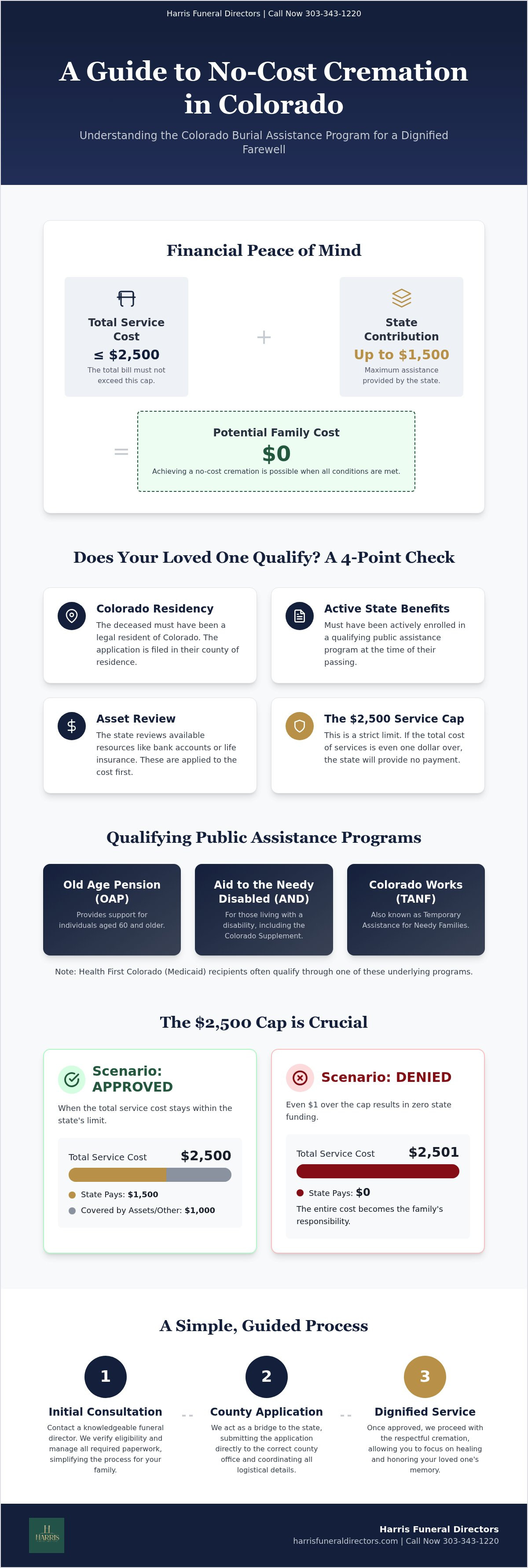
It's vital to remember that the total cost of the cremation cannot exceed $2,500 for the state to provide the grant. If the service price is higher than this cap, the state will not provide any payment at all. We can help you review these details to ensure your arrangements stay within the state's strict limits for a no-cost cremation for medicaid recipients Colorado. If you're unsure about your loved one's status, you might find it helpful to look at our services overview to see how we structure these arrangements to meet state requirements.
Calculating Costs: The $1,500 Benefit and the $2,500 Cap
Understanding the financial math is essential for achieving a no-cost cremation for medicaid recipients Colorado. The state provides a maximum grant of $1,500 to help cover the essential expenses of a final goodbye. While this support is a significant relief, it comes with a very strict "all or nothing" rule regarding the total cost of the services. If the funeral home's total bill is even one dollar over the state's limit, the entire grant is forfeited. This makes choosing a provider who respects these boundaries just as important as the eligibility of the deceased.
Colorado is unique because it offers robust Medicaid Funeral Assistance through its Department of Human Services, a benefit that many other states don't provide. However, the state expects the total cost of a cremation or burial to remain modest. This ensures that public funds are used for dignified, basic services rather than elaborate ceremonies. When assets like life insurance or small bank accounts are present, the state applies those funds first, which may reduce the final amount the state contributes toward the $1,500 maximum.
Navigating the $2,500 Total Cost Rule
The state's $2,500 ceiling includes every single charge on the funeral home's invoice. This encompasses the transportation of your loved one, the cremation process itself, all required permits, and the filing of the death certificate. If the total of these items exceeds $2,500, the state will not issue a payment. This rule is non-negotiable. At Harris Funeral Directors, we specifically design our pricing and packages to remain within these legal limits. We believe you shouldn't lose your state benefits because of rigid or high pricing structures from a provider.
Calculating Your Out-of-Pocket Responsibility
Your final balance depends on the deceased’s assets and the total service price. In Scenario A, if there are no assets and the service is priced at $1,500, the state covers the entire bill, resulting in a truly no-cost cremation for medicaid recipients Colorado. In Scenario B, if the deceased left behind $300 in a savings account, the state reduces its $1,500 grant by that amount. If the service still costs more than the remaining $1,200 grant, the family or the estate would be responsible for the difference up to the $2,500 cap. The state pays the funeral home directly, never as a reimbursement to the family. We work closely with you to review these numbers transparently before any paperwork is signed.
How to Apply for Burial Assistance in Colorado
Applying for state benefits can feel like a daunting task when you're already carrying the weight of a recent loss. We're here to help you move through this process with clarity and grace. To secure a no-cost cremation for medicaid recipients Colorado, the first step is actually reaching out to us. We serve as your advocate, ensuring that every detail is handled correctly from the very beginning. You'll need to gather a few essential pieces of information, such as the deceased’s Social Security Number, proof of their public assistance enrollment, and statements regarding any remaining assets or life insurance.
Once we have these details, the application is submitted to the Human Services office in the county where your loved one resided. Colorado law requires that this application be filed within one year of the date of death. It's important to wait for county approval before paying any portion of the bill, as paying in full beforehand can disqualify you from receiving the state grant. The county will review the documents and notify us directly of their decision, allowing us to proceed with the care of your loved one. This direct payment system is designed to reduce your personal financial burden during a sensitive time.
Where to File Your Application
If you're in the Denver or Aurora area, you'll likely work with the Adams, Arapahoe, or Denver County offices. Many counties, including Denver and Boulder, now offer the convenience of online applications through the Colorado PEAK website. Other areas, like Adams County, often prefer initial screenings via email to speed up the process. No matter which county you're in, we can help you identify the correct office and the most efficient way to submit your claim. Filing correctly the first time helps avoid unnecessary delays in your loved one's arrangements.
The Role of Your Funeral Director
We act as more than just a service provider; we're your partner in navigating the state bureaucracy. Our team is experienced in helping families complete the IM-14 and other state-required forms accurately. We verify eligibility early on so there are no stressful surprises later. If you're currently facing an immediate need for support, please reach out so we can begin this process alongside you. We handle the logistics and the communication with state agencies so you can focus on what truly matters: saying goodbye with dignity and love.
Dignified Care: Why Harris Funeral Directors is Your Partner
Choosing a partner during a time of loss is a deeply personal decision. We believe that every family deserves the same level of attentive care, regardless of their financial circumstances. Our team acts as a steady advocate, ensuring that your loved one's legacy is honored with the sincerity it deserves. We have extensive experience with the 2026 Colorado burial regulations; this allows us to provide a seamless experience when arranging a no-cost cremation for medicaid recipients Colorado. Unlike corporate entities driven by monthly quotas, we're family-owned and focused entirely on the people we serve. Our "Compassionate Guide" philosophy means we walk beside you, handling the technical details so you can focus on your family.
Transparency is the cornerstone of our service. We understand the strict $2,500 state-mandated cap and work diligently to ensure your arrangements stay within these legal boundaries. You won't find hidden fees or high-pressure sales tactics here. Instead, you'll find a team committed to honesty and clarity. We believe that financial stress should never be a barrier to a dignified farewell, and we take pride in helping our neighbors access the benefits they've earned through the state's assistance programs.
Honoring Your Loved One in Aurora and Denver
Our roots are deep in this community. We provide a calm, respectful environment for families in Aurora, Denver, and Commerce City. Over the years, we've developed a profound understanding of how to support those relying on state assistance without ever compromising on the quality of the service. You can learn more about why families choose Harris Funeral Directors to support them through these difficult moments.
Beyond the Paperwork: Emotional Support
Healing involves more than just final arrangements. Our support extends beyond the technical paperwork to include meaningful grief resources that help you find a path forward. For those who have served our country, we also provide specialized assistance. We understand the nuances of veteran-specific Medicaid benefits and help ensure your hero receives the honors they earned. Understanding our veteran services can help you see how we integrate state support with military tradition.
We're here to ensure that every Coloradan is laid to rest with the respect they deserve. By choosing a local partner who understands the local landscape, you're choosing peace of mind. We'll handle the county communication, the state forms, and the logistical coordination. Our goal is to provide a no-cost cremation for medicaid recipients Colorado that honors the life lived while protecting the family's future. When you're ready, we're here to listen and to lead with compassion.
Securing a Dignified Farewell for Your Loved One
Navigating the state's burial assistance program doesn't have to be a source of anxiety during your time of grief. By staying within the mandatory $2,500 total cost limit and coordinating closely with your local county office, you can honor your family member's legacy without an unexpected financial burden. Achieving a no-cost cremation for medicaid recipients Colorado is a practical reality for many families who partner with a provider that respects these strict state boundaries and understands the local landscape.
As a family-owned and operated home in Aurora, we specialize in the complex Medicaid and state assistance paperwork that often feels overwhelming for grieving families. Our transparent pricing is designed to protect your eligibility and ensure a sincere, dignified service for your loved one. If you're ready to begin the application process or need immediate support, please contact Harris Funeral Directors for help with Medicaid Cremation. You don't have to walk this path alone; we're here to provide the steady guidance and compassion your family deserves during this difficult chapter.
Common Questions About Medicaid Cremation in Colorado
Does Medicaid cover the full cost of cremation in Colorado?
Medicaid itself is a healthcare program and does not directly pay for final arrangements. Instead, the Colorado Burial Assistance Program provides a grant of up to $1,500 to help cover these expenses. When you work with an affordable provider, this state benefit can lead to a no-cost cremation for medicaid recipients Colorado. The funds are paid directly to the funeral home to ensure the individual receives a dignified rest.
How much does the state of Colorado pay for burial assistance in 2026?
In 2026, the maximum state contribution for burial or cremation services is $1,500. This grant is intended to cover the essential costs of the process, including the cremation itself and necessary permits. It's important to note that the state will look at the deceased's assets and life insurance first. Any available funds from the estate will reduce the final amount the state pays toward that $1,500 limit.
Can I get a no-cost cremation if my loved one was on Health First Colorado?
Yes, being enrolled in Health First Colorado is one of the primary ways to qualify for the state's burial assistance grant. This program is specifically designed to support individuals who were receiving medical or public assistance at the time of their passing. We can help you verify your loved one's eligibility and coordinate with the county to secure these benefits on your family's behalf.
What happens if the cremation costs more than $2,500?
If the total cost of the cremation or burial exceeds $2,500, the state will not provide any financial assistance at all. This $2,500 cap is a strict legal limit that includes every charge on the funeral home's invoice. To protect your eligibility for the state grant, we ensure our service packages are priced to stay within this mandatory ceiling while maintaining a high standard of care.
Will the state reimburse me if I have already paid for the cremation?
No, the Colorado Burial Assistance Program does not offer reimbursements to families for bills that have already been settled. The benefit is structured as a direct payment from the county to the funeral service provider. It's vital that you don't pay the bill in full before the county approves the application, as doing so will cause the state to withhold the payment entirely.
How long does it take for the county to approve burial assistance?
Approval times vary depending on the specific county office and the completeness of your application. While some counties process claims relatively quickly, others may take longer to verify all financial records. Using digital submission tools like the Colorado PEAK website can often help move the process along. We maintain regular communication with county caseworkers to keep you updated on the status of your loved one's claim.
Can I have a memorial service if I use Medicaid burial assistance?
The state grant is designed to cover the basic and necessary costs of cremation or burial only. It does not provide funds for memorial events, flowers, or upgraded merchandise. Because adding these services often pushes the total bill over the $2,500 eligibility cap, most families choose to hold private memorial gatherings separately. This approach ensures you remain eligible for the no-cost cremation for medicaid recipients Colorado.
What documents do I need to apply for Colorado burial benefits?
You'll typically need the deceased's Social Security Number, proof of their assistance enrollment, and statements for any bank accounts or life insurance policies. The state also requires information regarding the assets of a surviving spouse. Gathering these documents early allows us to help you complete the application accurately and submit it to the county office within the required one-year timeframe after the passing.


