

Did you know that in Colorado, a single dollar over a specific price limit could disqualify your loved one from receiving state burial assistance? It's a stressful reality for many families who are already managing the weight of grief. When you're trying to honor a legacy, the last thing you should have to worry about is a complex web of regulations. Understanding colorado medicaid funeral benefits is essential because the state's strict $2,500 total cost cap means that even a small oversight can lead to a denial of support.
We understand that you're looking for a way to provide a dignified service without the fear of unmanageable out-of-pocket costs. You deserve a clear, stable path forward during this difficult time. This guide provides a straightforward look at the 2026 eligibility requirements and a step-by-step plan to secure the $1,500 maximum grant. We'll show you how to find a compassionate funeral provider who handles the administrative burden and paperwork for you, so you can focus on remembering your loved one instead of filling out forms.
What Are Colorado Medicaid Funeral Benefits in 2026?
The Colorado Burial Assistance Program is a specialized financial safety net designed to help families manage the costs of final arrangements. When a loved one was receiving public assistance at the time of their passing, the state may contribute a grant to help cover the expenses of a funeral, burial, or cremation. While many people refer to this support as colorado medicaid funeral benefits, the program is technically a part of the state's Adult Financial assistance framework. It is managed at the county level by departments of human services, ensuring that help is available within the local community where the deceased resided.
For families in the Aurora and Denver metro area, these benefits are particularly vital. The high cost of living in our region often extends to final services, making the state's contribution an essential resource for maintaining financial stability during a time of loss. The broader Medicaid program, known in our state as Health First Colorado, provides the foundation for this eligibility, but the burial grant itself is a distinct benefit with its own specific rules. To see how these state contributions apply to different types of arrangements, you can review our services overview for more detailed information.
The Core Purpose of the Burial Assistance Program
The primary goal of this program is to ensure that every Colorado resident receives a dignified final farewell, regardless of their financial circumstances. It provides direct financial relief to families who might otherwise struggle to afford even the most basic services. The state defines burial services broadly; this includes the professional fees of a funeral director, the preparation of the deceased, and the costs associated with a casket, urn, or cemetery space. By offering a maximum contribution of $1,500, the state helps bridge the gap for those who have no other resources, such as life insurance or a significant estate, to pull from. It acts as a promise that dignity is a right, not a privilege.
Key Programs That Qualify for Assistance
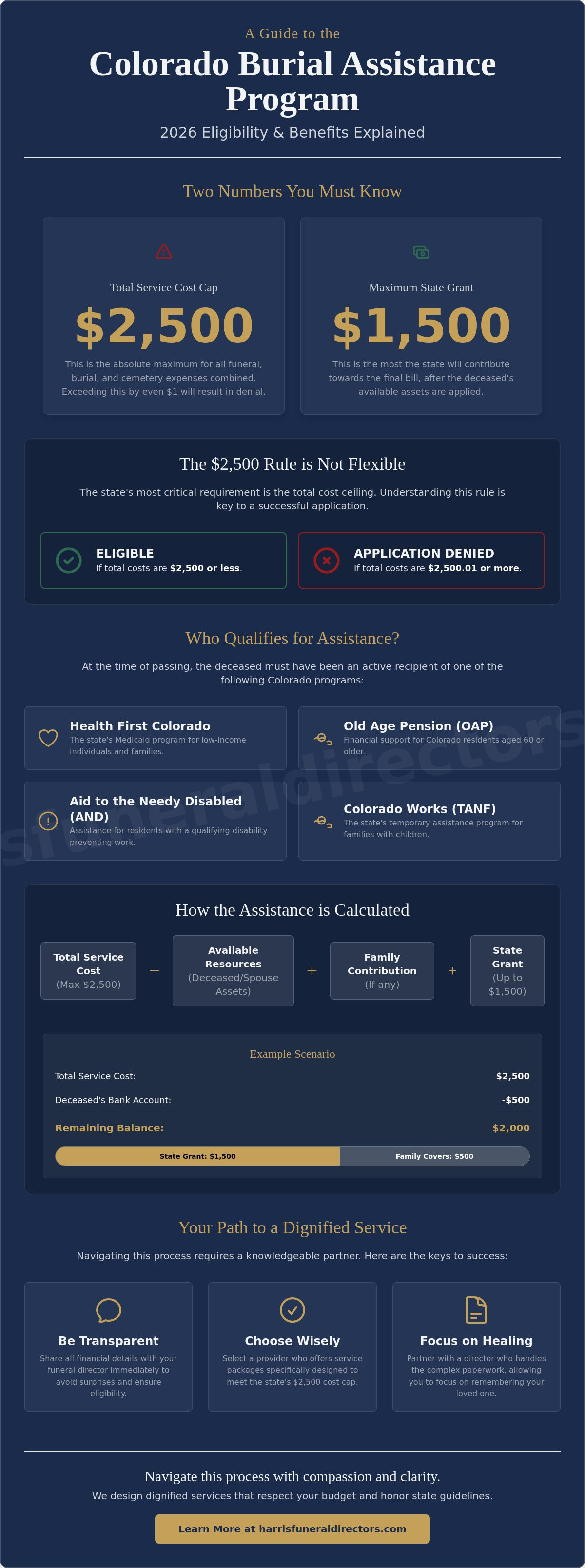
Eligibility for colorado medicaid funeral benefits is strictly tied to the deceased's enrollment in specific public assistance programs at the time of their death. It's not enough to simply be low-income; the individual must have been an active recipient of one of the following:
- Health First Colorado: This is Colorado's Medicaid program for low-income individuals and families.
- Old Age Pension (OAP): Support specifically for Colorado residents aged 60 or older.
- Aid to the Needy Disabled (AND): Assistance for residents with a qualifying disability that prevents them from working.
- Colorado Works (TANF): The state's temporary assistance program for families with children.
Eligibility Requirements and the $2,500 Total Cost Rule
Securing colorado medicaid funeral benefits requires more than just meeting residency or program criteria. It also involves adhering to a strict financial ceiling established by the state. Colorado has set a firm $2,500 total cost limit for all final arrangements. This means that the combined price of the funeral home services, the casket or urn, and any cemetery fees cannot exceed this amount. If the total bill goes even a single dollar over this cap, the state will typically deny the entire application for assistance. This rule is often the most stressful part of the process for families, as it limits the ability to add personal touches or upgrades to a service.
The state views this program as a resource of last resort. According to the guidelines maintained by the Colorado Burial Assistance Program, any resources owned by the deceased must be applied to the cost of the service first. These resources include bank accounts, cash on hand, or life insurance policies where the estate is the beneficiary. Additionally, the state considers the financial resources of a legally responsible spouse. If a spouse has enough savings to cover the $2,500 cost, the state may determine that public assistance isn't necessary. We recommend speaking with a professional who understands these nuances before making any financial commitments.
Calculating Your Potential Assistance
The state uses a specific formula to determine the actual grant amount. They take the total cost of the service, which must be $2,500 or less, and subtract any available resources from the deceased or their spouse. The remaining balance is what the state will pay directly to the funeral home. It's important to remember that the state will not reimburse a family for a bill that has already been paid in full. The maximum benefit for the 2026 calendar year is $1,500. This means if a service costs $2,500 and the deceased had $500 in a bank account, the state would contribute $1,500, leaving the family to cover the remaining $500.
The Importance of Transparency in Pricing
Honesty and transparency are your best tools when applying for these benefits. You must share all financial details with your funeral director during your very first conversation. This allows the director to guide you toward options that stay within the mandatory $2,500 limit. Many families face benefit denial simply because they didn't realize that a specific cemetery fee or a memorial item pushed them over the cap. To help families avoid these pitfalls, Harris Funeral Directors designs specific service packages that fit within these state-mandated limits. By choosing a provider that understands the paperwork, you can ensure that your loved one receives a dignified service without risking your eligibility for state support. If you're feeling overwhelmed, you can always reach out for guidance on how to structure these arrangements respectfully.
Comparing Cremation and Burial Options Under Medicaid
Choosing how to honor a loved one is a deeply personal decision. When you are working within the framework of colorado medicaid funeral benefits, that choice is often guided by the state's $2,500 total cost limit. This cap applies to the entire arrangement, including the funeral home's professional fees and any third-party costs like cemetery charges. Because of these financial boundaries, families must weigh the simplicity of cremation against the tradition of a burial to see which path best honors their loved one's legacy while remaining eligible for state support.
In Colorado, where approximately 76% of residents now choose cremation, the "No-Cost Cremation" model has become a reliable option for many. Since the state provides a maximum grant of $1,500, a direct cremation often fits entirely within that contribution. This eliminates the financial burden on the family while ensuring a respectful and dignified process. Families often find that county-level burial assistance guidelines help define what is possible within these financial boundaries.
Medicaid No-Cost Cremation in Aurora
Direct cremation is the most common choice for families utilizing state assistance. It is a straightforward, dignified process that focuses on the essentials of care. At Harris Funeral Directors, we specialize in coordinating these services to ensure they align with state requirements. This model typically covers the transportation of your loved one, the cremation process itself, and a basic container for the remains. By choosing this path, you can avoid out-of-pocket expenses entirely. You can learn more about our Cremation Services and how we support families through this transition.
Traditional Burial Services with Assistance
While cremation is common, traditional burial is still an option under the Burial Assistance Program. However, it requires very careful budgeting to stay under the $2,500 total cost cap. This budget must cover the casket, the professional services of the funeral home, and the cemetery's fees for the plot and the "opening and closing" of the grave. Most families choose a simple graveside ceremony to keep costs manageable while still providing a beautiful moment of closure. We invite you to explore our Traditional Burial Guide to see how these services can be tailored to meet both your emotional and financial needs.
To maintain eligibility for colorado medicaid funeral benefits, it's helpful to understand what is typically included in a qualifying package:
- Included: Local transportation of the deceased, professional care and preparation, a basic cremation container or simple burial casket, and assistance with the death certificate.
- Excluded: Premium wood or metal caskets, elaborate viewings with embalming, large floral tributes, or catered receptions.
The Step-by-Step Application Process in Colorado
Applying for colorado medicaid funeral benefits can feel like a daunting task when you're already managing a loss. It's helpful to remember that you don't have to walk this path alone. The first practical step is to notify the Department of Human Services in the county where your loved one lived. While the state allows you to submit an application up to one year from the date of death, starting the process early is always better. This ensures that the financial details are settled before the service takes place, giving you one less thing to worry about.
Once the county receives the notification, they'll verify that the deceased was an active recipient of a qualifying program. It's a precise process. The state pays the benefit amount directly to the funeral home rather than to the family. This arrangement is designed to simplify things for you. It ensures the funds are applied exactly where they're needed most. Because the program is a payer of last resort, they won't provide reimbursement for a bill that's already been paid in full by the family or another source. We can help you navigate these rules to ensure your application is handled correctly from the start.
Required Documentation for Families
To move forward, you'll need to gather several key pieces of information. Having these ready will speed up the county's review process. You'll generally need:
- Verification of Enrollment: Proof that your loved one was receiving Medicaid, OAP, AND, or TANF.
- Itemized Statements: A detailed list of services from your funeral provider that shows the total cost is $2,500 or less.
- Financial Records: Recent bank statements and life insurance policy details for the deceased.
- Social Security Number: The SSN of the deceased individual for identity verification.
Local County Offices for Aurora and Denver Residents
Because the program is administered at the county level, you must contact the specific office tied to the deceased's residence. For those in Aurora, this often means working with the Arapahoe County Department of Human Services or Adams County, depending on the specific neighborhood. Denver residents will work directly with Denver Human Services. Many families find it helpful to use the Colorado PEAK website. This online portal allows you to track the status of an application and upload documents digitally. If you're feeling overwhelmed by the paperwork, reach out to us for immediate assistance. We're familiar with the local county requirements and can help ensure your paperwork is in order before it's submitted.
Dignified Care: How Harris Funeral Directors Supports Your Family
At Harris Funeral Directors, we believe every life deserves a dignified farewell. Financial constraints should never stand in the way of a respectful tribute. As a family-owned firm serving the Aurora and Denver metro areas, we treat every family like our own. We understand that you're likely feeling the heavy weight of loss. Our goal is to lighten that burden by providing a steady, supportive hand throughout this entire journey.
Our team has deep experience managing colorado medicaid funeral benefits. We know the rules are strict. We know the $2,500 cap can feel restrictive when you want to provide the best for your loved one. However, we also know how to work within those boundaries to create a service that truly honors their legacy. We don't believe in a one-size-fits-all approach. Instead, we listen to your stories and help you choose the elements that matter most, ensuring the final arrangements are both meaningful and compliant with state regulations.
A Partner in the Application Process
One of the most stressful parts of this process is the administrative work. We take that off your plate. We coordinate directly with county caseworkers in Arapahoe, Denver, and Adams counties to ensure your application is moving forward. Our team handles the technical side of the arrangements so you don't have to. Our support includes:
- Direct Communication: We speak with county human services departments to verify eligibility.
- Compliant Billing: We prepare itemized statements that meet strict state audit standards.
- Budget Guidance: We help you select containers and services that stay under the $2,500 limit.
- Documentation Support: We assist in gathering the necessary asset and resource records for your filing.
We provide complete transparency from our first meeting. You'll always know exactly what is covered by the state and if there are any small gaps you need to consider. This clarity prevents the anxiety of unexpected bills during an already difficult time.
Personalized Support and Grief Resources
Our support doesn't end once the service is over. We're committed to walking alongside you as you begin your journey through healing. We offer access to comprehensive grief resources to help you and your family find strength. Choosing the right partner means finding a Compassionate Guide who values your peace of mind over everything else. We're here to answer your questions, simplify your decisions, and provide a sanctuary for your memories. If you're currently facing a loss and need help starting the process, please contact us for Immediate Need assistance. We're ready to help you secure the benefits your loved one deserves.
Honoring Your Loved One with Confidence and Peace
Managing the details of a final farewell is a profound responsibility. Knowing the specific rules of colorado medicaid funeral benefits, such as the strict $2,500 total cost cap and the direct payment process, helps you make informed choices during a time of high stress. Whether you choose a traditional burial or a no-cost cremation, the focus remains on providing a dignified goodbye that honors a unique life.
You don't have to navigate these complex state requirements alone. As a family-owned and operated firm in Aurora, we bring specialized expertise to every arrangement. We prioritize transparent, compassionate pricing to ensure your family feels supported and secure. Our team is dedicated to handling the administrative burden, allowing you to focus on what truly matters: remembrance and healing.
Let Harris Funeral Directors guide you through Medicaid benefits; contact us today. We're here to help you find clarity and peace as you celebrate a cherished legacy.
Common Questions About Colorado Medicaid Funeral Benefits
Does Colorado Medicaid pay for the full cost of a funeral?
No, the state does not cover the entire cost of a traditional funeral. Colorado provides a maximum burial assistance grant of $1,500, which is paid directly to the funeral home or crematory. This benefit is intended to provide a basic, dignified service rather than a full-service ceremony. Families are typically responsible for any remaining balance, though the total cost of the service must stay within strict state limits to remain eligible for the grant.
What happens if the funeral costs more than $2,500?
If the total cost of the final arrangements exceeds $2,500, the state will typically deny the application for colorado medicaid funeral benefits. This $2,500 limit is a strict cap that includes all professional fees, merchandise like caskets or urns, and third-party cemetery costs. To protect your eligibility, it is vital to work with a funeral director who understands how to structure a package that stays under this mandatory threshold.
Can I use life insurance and Medicaid benefits together?
You can use life insurance alongside state benefits, but the state considers those funds to be "available resources." The state's formula subtracts any insurance proceeds or bank balances from the total bill before calculating the grant. If a life insurance policy covers the entire cost of the service, the state will not provide additional assistance. The grant is only intended to cover the remaining balance after all other resources are used, up to $1,500.
Is there a specific time limit to apply for burial assistance in Colorado?
Yes, there is a clear deadline for filing. You must submit the application for burial assistance to the appropriate county office within one year of the date of death. While the state allows this one-year window, it's often best to start the process immediately. Early filing ensures all documentation is verified before the service takes place, preventing unexpected financial burdens for the family.
Which county do I apply in if my loved one lived in Aurora but passed away in Denver?
You must apply in the county where your loved one resided at the time of their death. If they lived in Aurora, you will work with Arapahoe County or Adams County Human Services, depending on their specific address. The location of the hospital or the place of passing does not determine which county manages the application; it's always tied to the individual's legal residence and the county that managed their benefits.
Does the Medicaid benefit cover the cost of a cemetery plot or headstone?
The grant can be used toward cemetery costs, but these expenses must fit within the $2,500 total cost cap. This includes the plot, the burial vault, and the labor for opening and closing the grave. Because cemetery fees can be quite high, many families find that colorado medicaid funeral benefits are most effectively used for cremation services, which allow for a dignified farewell without exceeding the state's financial limits.
How do I know if my loved one was receiving a qualifying program like OAP or AND?
You can verify their enrollment by checking their mail for letters from the Colorado Department of Human Services or looking for specific direct deposits in their bank statements. Look for mentions of Health First Colorado, Old Age Pension (OAP), or Aid to the Needy Disabled (AND). You can also log into the Colorado PEAK website or contact their local county caseworker to get official confirmation of their benefit status.
Can Harris Funeral Directors help me fill out the state application forms?
Harris Funeral Directors provides comprehensive support to help you manage the administrative side of this process. While the family must technically initiate the application, we coordinate directly with county caseworkers and provide the necessary itemized billing statements required for the state audit. We help ensure your paperwork is accurate and complete, reducing the risk of a denial and allowing you to focus on honoring your loved one's legacy.


