
No family should have to choose between honoring a loved one and keeping the lights on. Yet for many families in Aurora and across the country, that is the quiet, heartbreaking reality that follows an unexpected loss. The weight of grief is heavy enough on its own, without the added burden of figuring out how to cover funeral costs when financial resources are stretched thin. If you're searching for burial assistance for low income families, please know that real help exists, and you don't have to navigate this alone.
You already know how overwhelming this moment feels. The paperwork, the phone calls, the costs you weren't prepared for - it's a lot to carry while you're grieving. That's a completely understandable place to be, and you're not alone in it.
This guide is here to make things clearer. You'll find a straightforward breakdown of the assistance options available to low-income families, including Medicaid no-cost cremation, local resources in Aurora, and the steps you can take to apply with confidence. Consider this your steady, practical companion through a process that, with the right information, can be far more manageable than it first appears.
Understanding Burial Assistance for Low-Income Families
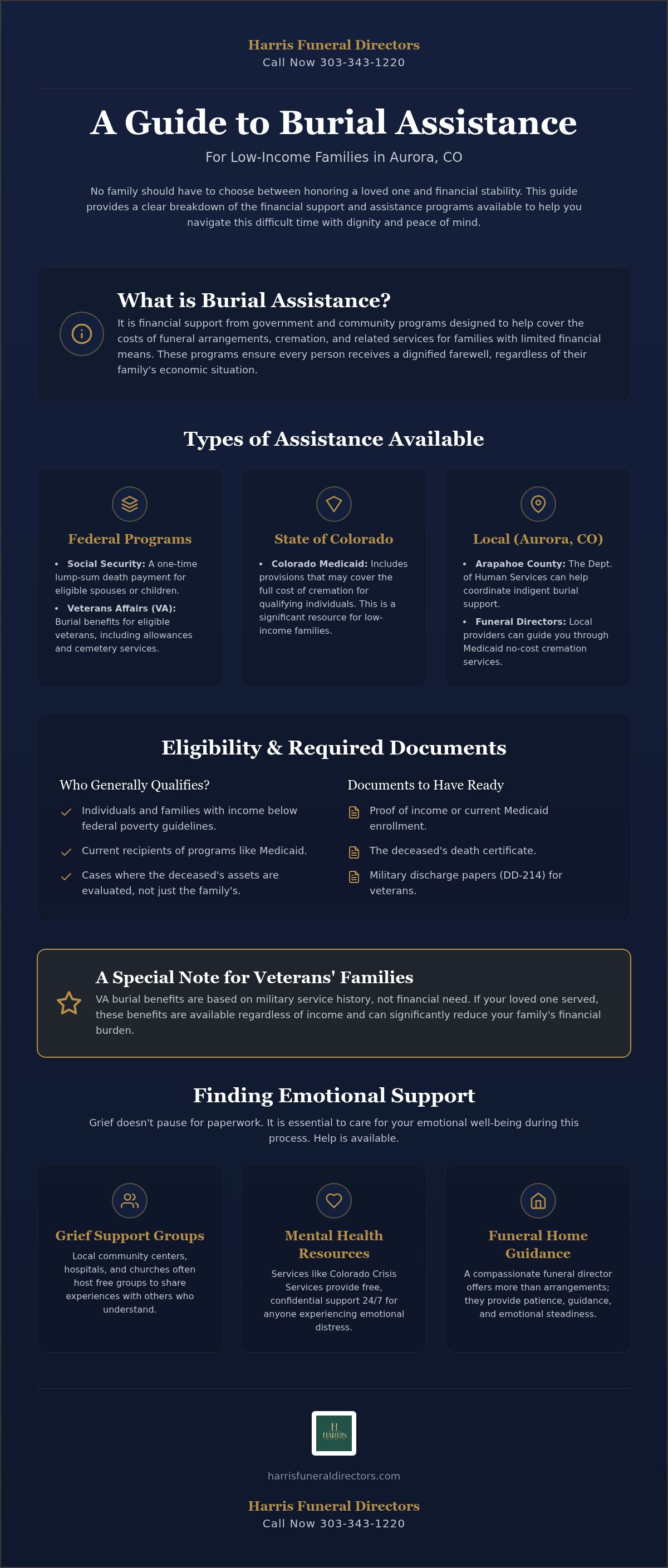
Burial assistance for low income families refers to financial support programs designed to help cover the costs of funeral arrangements, cremation, and related services when a family simply doesn't have the means to pay out of pocket. These programs exist at multiple levels of government and within local communities, and understanding how they fit together is the first step toward finding real relief during an impossibly hard time.
The need for this kind of support is genuine and widespread. Funeral costs can be substantial, and for families already managing tight budgets, an unexpected loss can create a financial crisis on top of an emotional one. Assistance programs exist precisely because society recognizes that every person deserves a dignified farewell, regardless of their family's financial circumstances.
Types of Burial Assistance Available
Help comes from several directions, and knowing each source helps you build a clearer picture of what you may be able to access:
- Federal programs: The Social Security Administration offers a small lump-sum death payment to eligible surviving spouses or dependent children. The U.S. Department of Veterans Affairs provides burial benefits for eligible veterans, including burial in a national cemetery, a grave marker, and in some cases a burial allowance.
- State programs in Colorado: Colorado's Medicaid program includes provisions that may cover cremation costs for qualifying individuals. This is one of the most meaningful options available to low-income families in the state, and it's worth exploring early in the process.
- Local resources in Aurora, CO: Aurora residents have access to county-level assistance through the Arapahoe County Department of Human Services, which can help coordinate indigent burial support. Local funeral homes familiar with the community, like Harris Funeral Directors, can also guide families through available options, including Medicaid no-cost cremation services.
Who Qualifies for Burial Assistance?
Eligibility varies by program, but most share a few common criteria. Income limits are typically tied to federal poverty guidelines, and some programs assess the assets of the deceased rather than the surviving family. Here's what you'll generally need to have ready:
- Proof of income or current Medicaid enrollment
- The deceased's death certificate
- Documentation of the relationship to the deceased
- Military discharge papers (DD-214) for veterans' benefits
Veterans and their families deserve a special note here. VA burial benefits don't require financial hardship as a condition; eligibility is based on service history and discharge status. If your loved one served, these benefits are available regardless of income, and they can significantly reduce the financial burden your family is facing.
One common misconception is that seeking assistance somehow diminishes the honor of a loved one's farewell. It doesn't. These programs exist to protect dignity, not compromise it. Reaching out for help is a practical, responsible step, and it's one that many families in Aurora take every year.
Emotional Support During the Burial Assistance Process
Grief doesn't pause while you fill out paperwork. It sits with you through every phone call, every form, every decision that feels impossible to make when your heart is already carrying so much. Understanding that the emotional weight of this process is real, and that it deserves just as much attention as the practical steps, is one of the most important things you can hold onto right now.
The Importance of Emotional Well-Being
Grief affects more than your mood. It affects your memory, your concentration, and your ability to weigh options clearly. Families navigating burial assistance for low income situations often face a compounded kind of stress, managing financial uncertainty while simultaneously processing loss. Recognizing this isn't a weakness; it's an honest acknowledgment of what you're carrying.
When grief clouds your thinking, even straightforward decisions can feel paralyzing. This is why emotional support isn't a luxury during this time; it's genuinely practical. Families who have someone to talk to, whether a counselor, a trusted friend, or a support group, often find they're better able to move through the necessary steps with greater clarity and less exhaustion. Connecting with a grief counselor early, even for a single conversation, can make a meaningful difference in how you experience the days ahead.
Finding Local Support Resources
Aurora and the surrounding Arapahoe County area offer several avenues for emotional support during bereavement. Consider reaching out to any of the following:
- Grief support groups: Many local churches, community centers, and hospitals in the Aurora area host free or low-cost grief support groups. These gatherings offer a space to be heard by people who genuinely understand what loss feels like.
- Mental health resources: Colorado Crisis Services provides free, confidential support around the clock for individuals experiencing emotional distress. Their walk-in centers and phone line are available to anyone in the state.
- Funeral home guidance: A compassionate funeral home does more than coordinate arrangements. Family-owned providers like Harris Funeral Directors understand that families need emotional steadiness alongside practical help. Their team approaches every family with patience and genuine care, walking alongside you rather than simply processing your case.
Don't underestimate the people already in your life, either. Leaning on family members, close friends, or a faith community isn't a burden you're placing on others; it's allowing the people who love you to show up in the way they want to.
If you're unsure where to start, the grief resources page at Harris Funeral Directors offers a thoughtful starting point for families seeking both emotional guidance and practical direction during one of life's hardest seasons.
How to Apply for Burial Assistance
Knowing that help exists is one thing. Actually reaching it is another. The application process for burial assistance for low income families can feel daunting when you're already exhausted, but broken down into clear steps, it becomes far more manageable. This section walks you through exactly what to gather, where to go, and what to expect once you've submitted your request.
Preparing Your Application
Before you make a single phone call, take a moment to gather your documents. Having everything in one place before you begin will save you time and reduce the back-and-forth that can slow the process down when time matters most.
Here's what most programs in Colorado will ask for:
- The deceased's death certificate: You'll typically need a certified copy, not a photocopy. Request several when the certificate is issued, as multiple agencies may require their own copy.
- Proof of income or Medicaid enrollment: Recent pay stubs, a benefit award letter, or documentation of current Medicaid enrollment will serve this purpose.
- Proof of your relationship to the deceased: A birth certificate, marriage certificate, or other legal document establishing your connection.
- Photo identification: A valid government-issued ID for the person applying on behalf of the family.
- Funeral home documentation: A signed statement or itemized cost list from your chosen funeral provider confirming the services being requested.
Read through the application form carefully before filling it out. Incomplete submissions are one of the most common reasons for delays. If a question doesn't apply to your situation, write "N/A" rather than leaving it blank, as blank fields can trigger requests for additional information.
Submitting Your Application
In Aurora and Arapahoe County, the primary point of contact for indigent burial assistance is the Arapahoe County Department of Human Services. They can be reached directly and will guide you through county-level support options. For Medicaid-related cremation coverage, your funeral home plays a central role; providers like Harris Funeral Directors have direct experience navigating this process and can submit the necessary documentation on your behalf, which removes a significant burden from your family's plate.
For veterans' benefits, applications are submitted through the U.S. Department of Veterans Affairs, either online through VA.gov or at a local VA regional office.
Once submitted, timelines vary. County programs may take several business days to process, while VA burial benefits can take longer depending on case complexity. Ask for a confirmation number or reference code when you submit, and don't hesitate to follow up if you haven't received a response within the timeframe you were given. Polite, consistent follow-up is entirely appropriate and often necessary.
If you're unsure where to begin, reaching out to a trusted local funeral home is a practical first step. The team at Harris Funeral Directors is familiar with the full range of available services, including burial assistance for low income families, and can help point you toward the right agencies without adding to your stress.
Additional Resources and Assistance Programs
The programs described earlier in this guide are a strong starting point, but they're not the whole picture. Aurora and the broader Arapahoe County community have a network of organizations, nonprofits, and local services that exist specifically to support families facing financial hardship during bereavement. Knowing where to look can open doors you didn't realize were there.
Local Programs Offering Support
Beyond county-level indigent burial assistance and Medicaid coverage, several additional avenues are worth exploring when seeking burial assistance for low income families in the Aurora area:
- Nonprofit organizations: Some local churches, faith-based charities, and community foundations offer emergency financial assistance that can be applied toward funeral and burial costs. Organizations affiliated with Catholic Charities of Denver and Jewish Family Service of Colorado have historically provided support to families in crisis, regardless of religious affiliation.
- Colorado Indigent Care Program (CICP): While primarily a healthcare assistance program, CICP serves as a useful reference point for families who don't qualify for Medicaid but still have limited income. Staff at these offices are often aware of related burial assistance channels and can point you in the right direction.
- Veteran service organizations: The Colorado Division of Veterans Affairs and local chapters of organizations like the American Legion and Veterans of Foreign Wars (VFW) can help connect eligible families with VA burial benefits and supplemental support. If your loved one served, don't overlook these organizations; they're experienced advocates who understand the benefits system well and can help move things along.
- Colorado 2-1-1: Dialing 2-1-1 connects you to a free statewide helpline that can identify local assistance programs based on your specific situation and ZIP code. It's a practical first call when you're not sure where to begin.
Community matters in moments like this. Families who reach out, even when it feels uncomfortable, often discover that genuine help is closer than they expected. You don't have to piece this together alone.
Contact Information for Local Resources
Here are direct points of contact to keep within reach:
- Arapahoe County Department of Human Services: (303) 636-1130 | arapahoegov.com
- Colorado 2-1-1 Helpline: Dial 2-1-1 or visit co.211.org
- Colorado Division of Veterans Affairs: (303) 894-7474 | vets.colorado.gov
- U.S. Department of Veterans Affairs Burial Benefits: va.gov/burials-memorials
When you're ready to talk through your options with someone who knows the local landscape, the team at Harris Funeral Directors is a natural first call. As a family-owned provider with deep roots in the Aurora community, they have direct experience helping families access burial assistance for low income situations, including Medicaid no-cost cremation. They can help you understand what you qualify for and take on much of the coordination so you don't have to carry that weight alone.
No question is too small. Asking for help is the right move, and the right people are ready to answer. Reach out to Harris Funeral Directors to get compassionate, straightforward guidance on your family's options.
Harris Funeral Directors: Your Compassionate Partner
When the practical weight of loss feels impossible to carry alone, having the right people beside you makes a genuine difference. Harris Funeral Directors is a family-owned funeral home with deep roots in the Aurora community, built on the belief that every family deserves dignified, compassionate care regardless of their financial circumstances. That belief isn't a marketing statement; it's reflected in how they actually work with families, one conversation at a time.
Why Choose Harris Funeral Directors?
What sets Harris Funeral Directors apart isn't just what they offer, it's how they offer it. Their team approaches every family with patience and transparency, walking you through available options without pressure or confusion. If you're seeking burial assistance for low income families, they'll tell you honestly what you qualify for, what documentation you'll need, and what steps come next. No guesswork. No unexpected surprises.
A few things families consistently find meaningful about working with Harris:
- Transparent pricing: Their pricing and packages are presented clearly, so you understand exactly what's included before any decisions are made.
- Medicaid no-cost cremation: Harris Funeral Directors has direct experience navigating Colorado's Medicaid cremation process and can handle much of the coordination on your behalf, reducing the administrative burden your family carries.
- Personalized care: As a family-owned provider, they don't treat your situation as a case to be processed. They treat it as a family to be supported.
- Local knowledge: Their familiarity with Arapahoe County resources and assistance channels means they can connect you with the right programs efficiently, without sending you on a frustrating search on your own.
Affordable burial options don't mean reduced care. Harris Funeral Directors holds that standard firm across every family they serve.
How to Get Started
Taking the first step is often the hardest part. If you're not sure what you need or where to begin, that's completely okay. You don't need to have answers before you reach out.
The simplest starting point is visiting the immediate need page on their website, where you can share your situation and hear back from someone who genuinely understands what you're facing. If you'd like to explore services and learn more before making any decisions, the services overview offers a clear picture of what's available, including options specifically designed for families navigating financial hardship.
You've already done something important by seeking information. The next step is simply a conversation, and Harris Funeral Directors is ready to have it with you.
You Don't Have to Figure This Out Alone
Losing someone you love is hard enough. The financial pressure that can follow shouldn't make it harder. This guide has walked through the key resources available to families in Aurora, from federal and state programs to county-level support and the practical steps for applying. The most important takeaway is this: burial assistance for low income families is real, accessible, and closer than it may feel right now.
Programs exist. People are ready to help. And asking for that help is not only appropriate, it's the right move for your family.
Harris Funeral Directors brings something that matters in moments like this: local knowledge, honest guidance, and genuine care from a family-owned team that understands what Aurora families are navigating. Affordable packages, Medicaid no-cost cremation support, and a team that treats every family as exactly that, a family, not a file.
When you're ready to take the next step, even if you're still unsure what that step looks like, reach out. Contact Harris Funeral Directors for compassionate assistance with burial costs. You don't have to carry this alone, and you won't have to.
Frequently Asked Questions About Burial Assistance for Low-Income Families
What types of burial assistance are available for low-income families?
Several distinct programs exist to help families manage funeral costs. At the federal level, the Social Security Administration offers a lump-sum death payment to eligible survivors, and the VA provides burial benefits for veterans. Colorado's Medicaid program can cover cremation costs for qualifying individuals, and Arapahoe County offers indigent burial support through its Department of Human Services. Local nonprofits and faith-based organizations sometimes provide emergency financial assistance as well.
How do I qualify for burial assistance programs in Colorado?
Qualification requirements vary by program. Most county and state programs assess income against federal poverty guidelines, and some evaluate the assets of the deceased rather than the surviving family. Medicaid-based cremation coverage generally requires that the deceased was enrolled in Medicaid at the time of death. The fastest way to confirm eligibility is to contact Arapahoe County Human Services directly or speak with a funeral provider experienced in burial assistance for low income families, who can help identify which programs apply to your specific situation.
What documents do I need to apply for burial assistance?
Most programs require certified copies of the death certificate, proof of income or Medicaid enrollment, a government-issued photo ID for the applicant, and documentation confirming your relationship to the deceased. You'll also typically need a signed statement or itemized cost list from your funeral provider. Gathering these materials before you begin any application will reduce delays and back-and-forth that can slow the process when time is short.
Can veterans receive additional burial benefits?
Yes, and these benefits don't require financial hardship to access. Eligible veterans may receive burial in a national cemetery, a government-furnished grave marker, and in some cases a burial allowance. Eligibility is based on service history and discharge status, not income. Local veteran service organizations, including Colorado chapters of the American Legion and VFW, can help families navigate the VA application process and advocate on their behalf if questions arise.
What should I do if I can't afford funeral costs?
Start by contacting a local funeral home that has direct experience with assistance programs. A provider like Harris Funeral Directors can walk you through Medicaid no-cost cremation and other affordable options without pressure. Calling Colorado 2-1-1 is also a practical early step; the helpline identifies local resources based on your ZIP code and can point you toward programs you may not have found on your own. Don't wait to ask for help; many families discover that support is more accessible than they expected.
How long does it take to process a burial assistance application?
Processing times vary depending on the program. County-level assistance through Arapahoe County Human Services typically takes several business days. VA burial benefit applications can take longer, particularly if service records need to be verified. When you submit any application, ask for a confirmation number and a realistic timeframe. Polite follow-up is appropriate if you haven't heard back within the window you were given. Working with a funeral home familiar with these processes can help move things along more efficiently.
Are there support resources available for families during this process?
Practical and emotional support are both available. Colorado Crisis Services offers free, confidential help around the clock for anyone experiencing emotional distress. Many Aurora-area churches, hospitals, and community centers host free grief support groups. A compassionate funeral home can also serve as a steadying presence throughout the process, not just for logistics but for the human side of what you're carrying. Leaning on these resources isn't a sign of weakness; it's a reasonable and healthy response to an extraordinarily hard season.


