

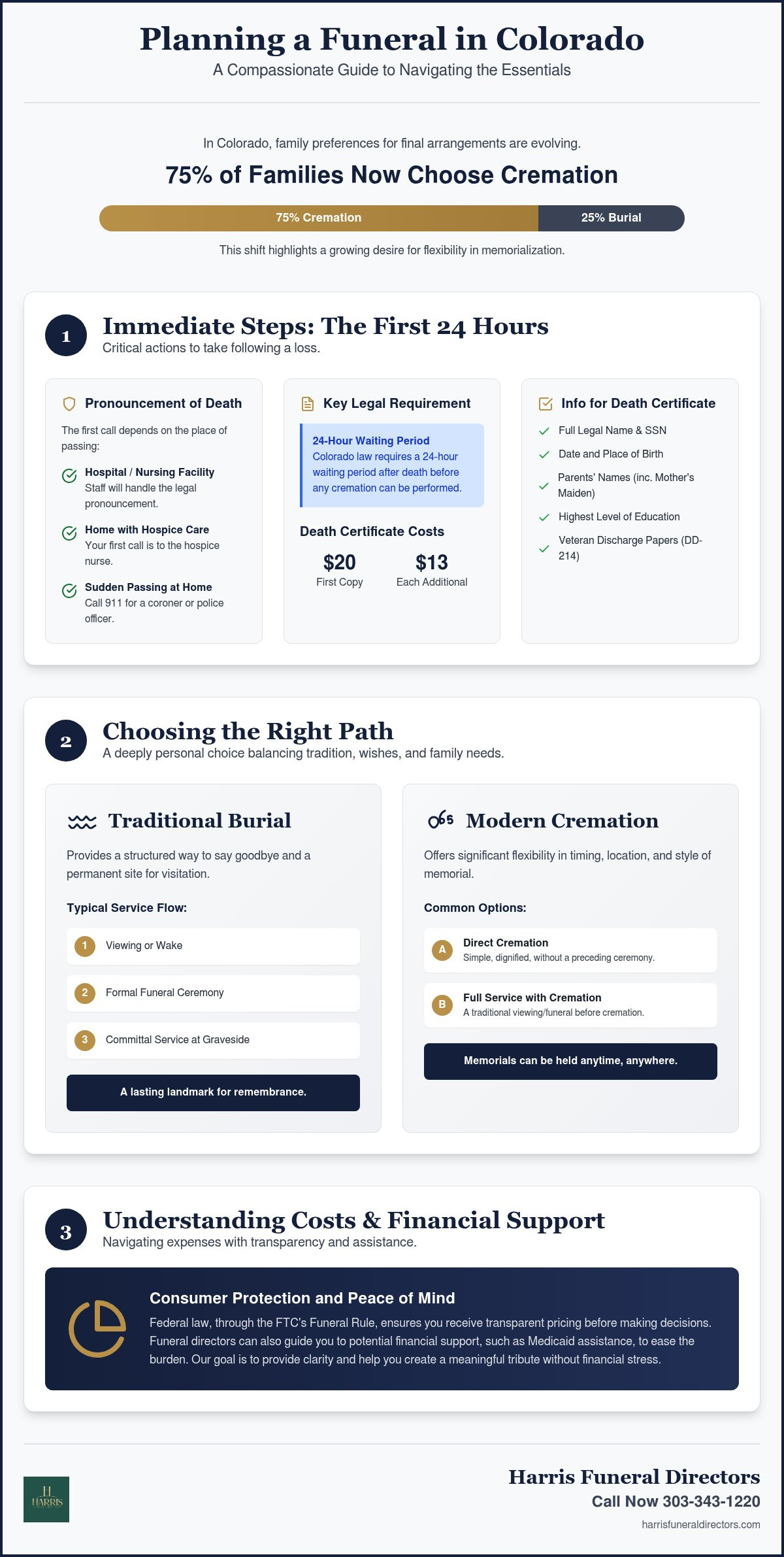
Did you know that 75% of families in our state now choose cremation over traditional burial? This shift reflects a growing desire for flexibility, yet many families still feel lost when they begin to research how to plan a funeral in Colorado. It's a heavy burden to carry; you're trying to process your own grief while managing complex legal requirements and the latest state regulations. You want to ensure every detail is handled with dignity, but the fear of hidden costs or missing a vital step can make an already painful time feel chaotic.
We understand the weight of these decisions and believe you deserve a steady hand to guide you. This article serves as your compassionate roadmap, offering the clear, expert-led advice needed to honor your loved one without the stress of the unknown. We'll walk through the essential checklist of immediate actions, explain how to access financial support like Medicaid assistance, and help you weigh your options between burial and cremation. Our goal is to provide the peace of mind that comes from knowing you've created a beautiful, respectful tribute that truly celebrates a life well lived.
Immediate Steps: The First 24 Hours in Colorado
The first few hours following a loss are often a blur of deep emotion and urgent requirements. While your heart needs space to grieve, there are practical steps that must be taken to ensure your loved one is cared for with dignity. Understanding how to plan a funeral in Colorado begins with the official pronouncement of death. This process depends entirely on where the passing occurred. If a loved one passes away in a hospital or nursing facility, the staff will handle the legal pronouncement. However, if the death occurs at home while under hospice care, your first call should be to the hospice nurse. In cases of a sudden passing at home without hospice, you must call 911 so that a coroner or police officer can respond.
Legal Pronouncements and Transportation
Colorado law requires that a qualified professional, such as a physician, coroner, or hospice nurse, officially pronounces the death. Once this is completed, you can begin making arrangements for transportation. We provide dignified transportation from hospitals and residences throughout Aurora and Denver, ensuring your loved one is moved with the utmost respect. It is helpful to remember that Colorado law requires a 24-hour waiting period after death before any cremation can be performed. This period allows for the completion of necessary legal reviews. During this time, you can reflect on the funeral practices and traditions that best honor your loved one's unique legacy and personal wishes.
The Role of the Funeral Director
Think of your funeral director as a trusted family advocate who stands by your side. For families facing a sudden loss, our Immediate Need process is designed to simplify these first steps. We take the lead on the complex paperwork required by the state, including the filing of the death certificate. Under the new 2026 Colorado regulations, funeral homes must maintain physical, inspectable locations and carry specific liability insurance, providing you with an extra layer of consumer protection and peace of mind. We will guide you through gathering the essential details needed for the state, such as:
- The deceased's full legal name and Social Security number.
- Date and place of birth.
- Parents' names, including mother's maiden name.
- Highest level of education completed.
- Veteran discharge papers (DD-214), if applicable.
In Colorado, the first copy of a death certificate costs $20, and each additional copy is $13. We help you determine how many copies you might need for life insurance, bank accounts, and property transfers. By handling these technical details, we allow you to focus on your family and the initial stages of your healing journey.
Choosing the Right Path: Burial vs. Cremation
Deciding on a final resting place is a deeply personal choice. It often involves balancing religious traditions, family expectations, and the specific wishes of the deceased. In Colorado, approximately 75% of families now choose cremation, yet traditional burial remains a cornerstone for many who find comfort in a permanent, physical site for visitation. Neither choice is inherently better. The right path is the one that brings your family the most peace while honoring the legacy of your loved one. When you are learning how to plan a funeral in Colorado, it helps to view these options as the foundation for the healing journey ahead.
Traditional Burial Services in Aurora
For many, a traditional service provides a structured way to say goodbye. This typically involves a viewing or wake, a formal funeral ceremony, and a committal service at the graveside. Selecting a casket and a cemetery plot in the Denver metro area can feel overwhelming, but we help simplify these choices by focusing on what best reflects your loved one's personality and values. If you would like to explore this option further, our guide on Traditional Burial Services in Aurora offers a detailed look at the process. We believe that a burial site serves as a lasting landmark for remembrance, providing a quiet space for future generations to visit and reflect.
Cremation Options and Flexibility
Cremation has grown in popularity because it offers significant flexibility in timing and memorialization. You might choose a direct cremation, which is a simple and dignified process without a preceding ceremony. Alternatively, many families opt for a full funeral service with the body present before the cremation occurs. This allows for a traditional goodbye followed by the flexibility of keeping, burying, or scattering the ashes. To learn more about these modern choices, you can read our resource on Cremation Services in Aurora. Modern cremation packages are designed to be straightforward and respectful, removing the pressure of immediate decisions.
Regardless of the method you choose, remember that a memorial service is about the people left behind. You can hold a celebration of life in a park, a church, or even a family home. The logistics of the disposition don't limit your ability to create a meaningful tribute. If you find yourself unsure which path to take, you can look at our pricing and packages to see how each option aligns with your family's needs and budget. Understanding these differences is a vital part of learning how to plan a funeral in Colorado with confidence and clarity. We are here to ensure that the path you choose is walked with dignity and support.
Understanding Colorado Funeral Costs and Financial Assistance
Cost is one of the most difficult topics to raise during a period of grief, yet avoiding it can lead to real financial hardship. One of the most important steps in learning how to plan a funeral in Colorado is understanding exactly what you're paying for before you sign anything. Federal law, through the Federal Trade Commission's Funeral Rule, requires every licensed funeral home to provide a General Price List, or GPL, upon request. This document itemizes every service and product offered, giving you the ability to compare options and select only what your family truly needs.
The GPL separates costs into two distinct categories. Professional service fees cover the funeral home's core work: staff time, coordination, facility use, and administrative tasks like filing paperwork. Cash advance items are third-party charges that the funeral home pays on your behalf, such as cemetery fees, obituary notices, and death certificate copies. These pass-through costs can add up quickly, so always ask for an itemized estimate that separates these two categories clearly. At Harris Funeral Directors, our pricing and packages are structured with this transparency in mind, so you'll never encounter a vague, bundled quote that obscures what you're actually receiving.
Families typically fund funeral arrangements through a combination of personal savings, life insurance policy assignments, and pre-need plans. If a life insurance policy exists, many funeral homes can work directly with the insurer to assign the benefit toward the balance, relieving the family of an immediate out-of-pocket burden. Pre-need planning, which we explore in detail later in this guide, is another powerful tool for eliminating financial uncertainty entirely.
Medicaid and No-Cost Cremation in Colorado
For families with limited financial resources, Colorado's Medicaid program offers meaningful end-of-life assistance. Qualifying individuals may be eligible for a state-funded cremation at no cost to the family. This benefit exists to ensure that every person receives a dignified farewell, regardless of their financial circumstances. Our detailed guide on Medicaid Cremation in Aurora walks through the process step by step. General eligibility considerations typically include:
- The deceased was enrolled in Colorado Medicaid at the time of passing.
- The estate holds insufficient assets to cover funeral expenses.
- No responsible party with sufficient financial means has assumed responsibility for costs.
- The family submits a timely application through the appropriate county department.
We assist families directly with this application process, helping gather the documentation required and submitting it correctly the first time. This is a gap that many funeral providers simply don't address, and it's a service we consider a core part of our commitment to Aurora families.
Veteran Benefits and Military Honors
Honorably discharged veterans and their spouses may qualify for a range of burial benefits through the U.S. Department of Veterans Affairs. These can include a burial allowance, a government-furnished headstone or marker, a burial flag, and Presidential Memorial Certificate. Presidential honors, including a military funeral honors ceremony with flag folding and the playing of "Taps," can be coordinated through the VA at no cost to the family. Coordinating these benefits requires your loved one's DD-214 discharge papers, which is why we included that document in the first-steps checklist earlier in this guide. Our dedicated Veteran Services page outlines every benefit available and explains precisely how we help families navigate the VA coordination process with the respect these heroes deserve.
Personalizing the Service: Honoring a Unique Legacy
Once the legal foundations are established, the focus of your journey shifts to the heart of the matter: the life being celebrated. A funeral is more than a logistical necessity. It's a vital opportunity to gather, remember, and begin the long process of healing. When you consider how to plan a funeral in Colorado, remember that the most meaningful services are those that reflect the unique personality and values of the individual. Personalization doesn't require a large budget; it requires an attentive eye for the details that made your loved one special.
The choice of venue sets the tone for the entire gathering. While many families find comfort in the traditional atmosphere of a chapel, others prefer a graveside service or a community space that held personal significance. Music, readings, and eulogies serve as the narrative thread of the ceremony, telling a story that goes beyond dates and titles. We also encourage the use of modern technology to ensure no one is left out. High-quality tribute videos and live-streaming services allow distant relatives to participate in the farewell, providing a sense of shared community even across great distances.
Planning for a post-service gathering is another essential step. Whether it's a formal reception or a quiet family meal at a home in Aurora, these moments of fellowship allow friends and family to share stories that might not be part of the formal service. This is where the real work of support happens, as people find strength in their collective memories.
Obituaries and Notifications
An obituary is the first public step in honoring a legacy. It should be more than a simple announcement of passing; it's a chance to craft a narrative that highlights your loved one's impact on the world. We provide a dedicated platform for Harris Funeral Directors Obituaries, which makes it easy to inform the community and provide details about the service. These digital memorials can be easily shared via social media or sent to local Aurora news outlets, ensuring that everyone who cared for your loved one has the chance to pay their respects.
Memorialization and Grief Support
The decisions you make regarding permanent memorials, such as choosing between a traditional headstone or a unique urn, are lasting tributes that will stand for generations. There is no need to rush these choices. We encourage families to take their time to ensure the memorial truly fits the person it represents. Healing doesn't end when the service is over. Accessing Grief Resources can be a transformative part of the weeks and months that follow, helping you navigate the complex emotions that remain.
If you are ready to begin crafting a tribute that truly reflects your loved one's spirit, we invite you to explore our personal services to see the many ways we can help you honor their legacy.
Securing the Future: Funeral Pre-Planning in Aurora
We've explored the immediate steps for those facing loss today, but another vital part of understanding how to plan a funeral in Colorado involves looking toward the future. Pre-planning is an act of foresight that provides profound relief to your loved ones before a crisis ever occurs. By documenting your wishes now, you ensure that your personal legacy is honored exactly as you envision it. This process also allows you to lock in today's rates for services, protecting your family from the natural rise in costs over time.
In Colorado, pre-need contracts are highly regulated to ensure your investment is secure. Whether you choose a trust-funded plan or an insurance-funded one, the funds are protected and often portable if you decide to move. Knowing how to plan a funeral in Colorado ahead of time means your plans can follow you, providing a sense of stability no matter where life takes you. It's a quiet, steady way to ensure that your final wishes are never a source of confusion or financial strain for those you leave behind.
The Pre-Planning Process
When you sit down to Plan Ahead with a funeral director, we break the process into manageable steps. We start by listening to your preferences for burial or cremation and any specific traditions you wish to include. Our guide on Funeral Pre Planning Aurora provides a deeper look at how these choices create a lasting legacy. You'll also decide on a funding method. Trust-funded plans place your money in a secure account until it's needed; insurance-funded plans use specialized life insurance policies to cover the costs. Both options offer unique benefits depending on your financial goals.
Peace of Mind for Your Family
Choosing to pre-plan is a final gift of clarity for your children and surviving family members. It replaces the stress of guesswork with the comfort of a clear, documented path. As your trusted family advocate, we facilitate these conversations with patience and transparency, ensuring every detail is captured without any sales pressure. If you're ready to secure your legacy and provide this peace of mind for your family, we invite you to reach out for a free pre-planning consultation. Taking this step today ensures that when the time comes, your family can focus entirely on honoring your life.
Honoring a Life with Confidence and Grace
Arranging a final tribute is one of the most significant responsibilities you'll ever undertake. We hope this guide has provided clarity on the immediate legal steps, the differences between burial and cremation, and the various ways to personalize a service. Understanding how to plan a funeral in Colorado doesn't have to be an overwhelming experience when you have a trusted partner by your side. Whether you're navigating Medicaid requirements or coordinating military honors, having the right information brings a much-needed sense of peace.
As a family-owned business with over 20 years of service in Aurora, Harris Funeral Directors is committed to being your compassionate guide. We specialize in Medicaid assistance and pride ourselves on transparent, affordable pricing packages that respect your family's needs. You don't have to walk this path alone. Download our free Colorado Funeral Planning Checklist or contact us for immediate support. We are here to help you create a legacy that truly reflects the beauty of the life you're honoring.
Frequently Asked Questions
How much does a typical funeral cost in Colorado?
The total cost depends on whether you choose burial or cremation and the specific services you select. When researching how to plan a funeral in Colorado, you'll find that professional fees, casket selection, and cemetery costs all play a role. Every provider must give you a General Price List so you can see itemized costs. This transparency is a legal requirement that helps you manage your budget effectively.
What is the most affordable way to handle a funeral in Aurora?
Direct cremation is the most economical choice for families in Aurora. This option bypasses the costs of embalming, formal viewings, and expensive caskets. By choosing a simple disposition, you can focus your resources on a personalized memorial service or celebration of life later. It's a dignified way to honor a loved one while staying within a specific financial plan that works for your family.
Does Colorado law require embalming?
Embalming is not required by Colorado law in most circumstances. Families are free to choose other methods of preservation, such as refrigeration, if they prefer a more natural approach. However, if you're planning an open-casket public viewing, some facilities may require embalming as part of their house policy. It's always best to discuss your preferences with your funeral director during the initial arrangement to ensure your wishes are met.
Can I plan a funeral in Colorado without a funeral home?
You are legally permitted to handle all funeral arrangements yourself in Colorado. This includes transporting the body, filing the death certificate, and arranging for burial or cremation. While this can be a deeply personal experience, it also requires navigating complex state regulations and permits. Many families find that a funeral director's expertise provides much-needed relief and ensures every legal requirement is handled correctly during a stressful time.
How do I obtain a death certificate in Colorado?
You can order death certificates through the Colorado Department of Public Health and Environment or your local county health department. As of July 2026, the state charges $20 for the first copy and $13 for each additional copy. Most families need several copies for banking, insurance, and legal matters. We typically handle the filing and ordering for you to ensure the process is as smooth as possible.
What happens if a loved one dies away from home?
If a passing occurs outside of Aurora, you should call your local funeral home immediately. We act as your advocate by coordinating with out-of-state providers and handling the logistics of shipping. This prevents you from having to manage multiple contracts in different locations. We ensure your loved one is returned home with the same dignity and care they would receive if the passing had occurred here.
Is Medicaid cremation really no-cost in Colorado?
Medicaid cremation is a no-cost option for qualifying individuals in Colorado. The state provides a specific burial assistance benefit that covers the essential costs of a simple cremation for those who meet financial eligibility requirements. We are specialists in this area and guide families through the paperwork to ensure they receive the full benefit. It's a vital resource for ensuring every member of our community receives a respectful farewell.
Can I pre-pay for my funeral in Colorado?
Pre-paying is an excellent way to lock in current rates and simplify the process for your family. Researching how to plan a funeral in Colorado often leads families to pre-need contracts, which are protected by state law. Whether you choose a trust or an insurance-funded plan, your investment is secure. This step ensures your wishes are followed exactly while removing future financial stress and difficult decisions from your children.


