

If you had to name the person with the legal right to make funeral decisions for your loved one right now, would you be certain of the answer? While we often think of loss in emotional terms, there is a structured legal process that begins the moment someone passes away. It's completely natural to feel overwhelmed by the weight of these responsibilities or to worry about missing a strict filing deadline while you're still in the earliest stages of grief.
We understand that you need clear, honest answers during this difficult time. This guide is designed to help you understand exactly what happens to a body after death legally in Colorado, providing a compassionate roadmap through the state's specific requirements. We'll walk you through the legal chain of custody, explain the 72-hour window for filing death certificates, and show you how a dedicated partner can handle the complex paperwork on your behalf. By understanding these steps, you can find a sense of calm and ensure your loved one is cared for with the dignity and respect they deserve.
The First Legal Step: Pronouncement and Reporting of Death
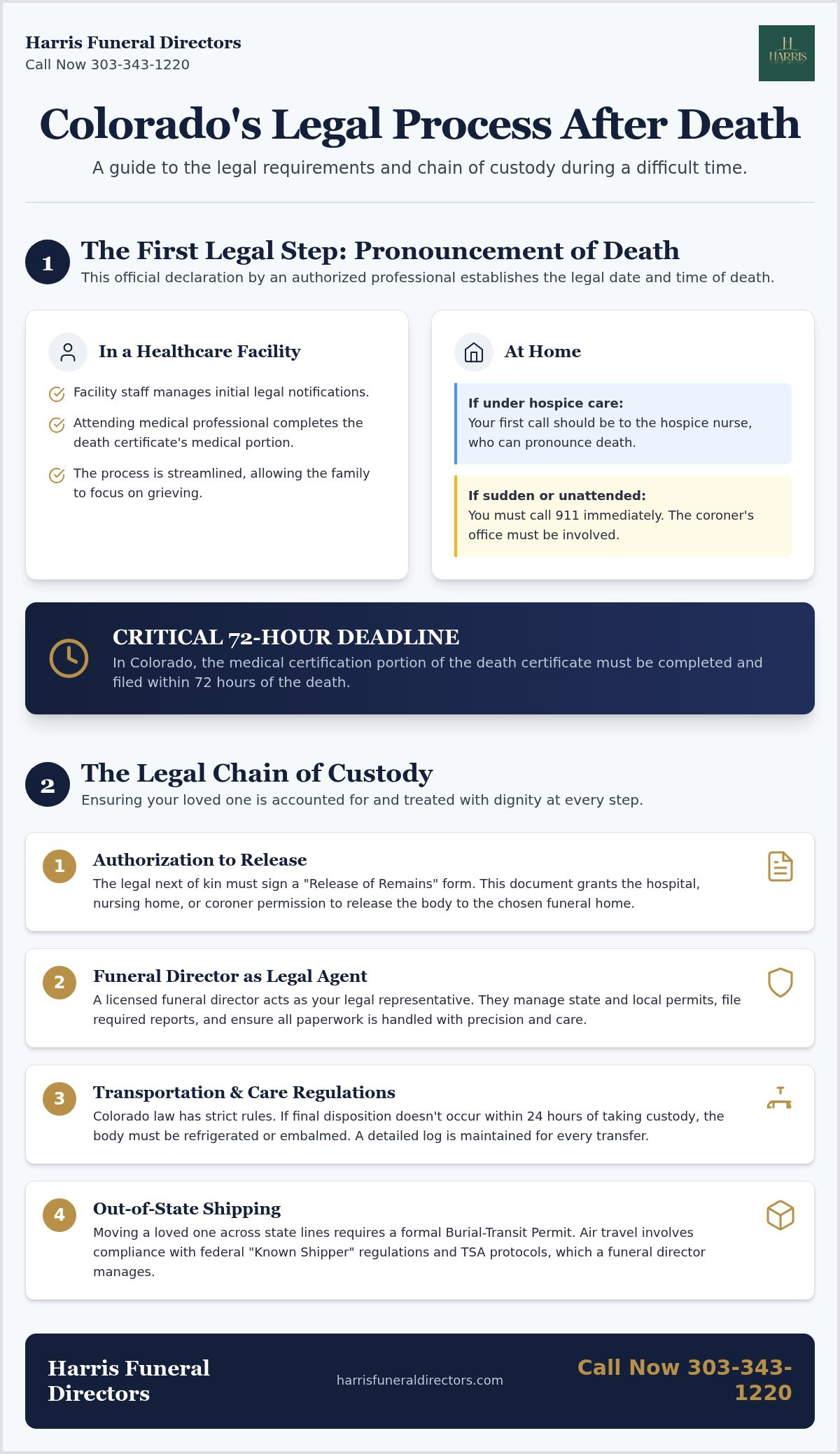
When a loved one passes away, the first official requirement is the pronouncement of death. This is the formal determination that life has ended, a concept often referred to as Legal death. This step isn't just a medical formality; it's the trigger for the entire legal chain of custody. In Colorado, this pronouncement must be made by an authorized professional, such as a physician, a registered nurse, or the county coroner. Understanding what happens to a body after death legally starts with this official declaration, as it establishes the date and time of death used on all future documents.
For deaths that occur unexpectedly or without a physician present, the County Coroner in Aurora or Denver takes legal custody of the body. They are responsible for investigating the cause of death and ensuring all legal reporting requirements are met. This oversight provides a layer of protection and clarity for both the family and the state. Any person who discovers a death under circumstances that may be unnatural, violent, or accidental must report it immediately to law enforcement or the coroner's office. This ensures the integrity of the legal record from the very beginning.
Deaths in a Healthcare Facility
When a death occurs in a hospital or nursing home, the facility's staff typically manages the initial legal notifications. The attending physician, physician assistant, or advanced practice registered nurse has a legal obligation to complete the medical certification portion of the death certificate within 72 hours. Once this is done, the facility will coordinate with your funeral home for the respectful transfer of your loved one. This process is usually streamlined. It allows you to focus on your family while the clinical staff handles the immediate paperwork and signatures required by Colorado law.
Deaths Occurring at Home
If a death happens at home, the next steps depend on the circumstances. If your loved one was under hospice care, your first call should be to the hospice nurse. They have the authority to pronounce death and can help you begin the process without involving law enforcement. However, if the death was sudden or unattended, you must call 911 immediately. In these cases, the coroner's office must be involved to legally determine the cause of death. Families in Aurora can then reach out to a funeral director to initiate the legal record. We act as your steady, experienced partner during this transition, helping you manage the initial reporting with dignity and care.
Our licensed funeral directors at Harris Funeral Directors manage all state and local permits, ensuring that every legal requirement is met with precision. Whether you are choosing traditional burial or cremation services, we handle the complex filings so you don't have to carry that burden alone. We serve as your trusted family advocate, making sure the transition from the place of death to our care is handled with the highest level of respect.
Legal Chain of Custody: Transferring the Deceased
Once the pronouncement is made, the physical transfer of your loved one marks the next major step in the legal process. This transition is a formal handoff of responsibility from a medical or state facility to our care. Understanding what happens to a body after death legally involves recognizing this "chain of custody." It's a secure, documented trail that ensures your loved one is accounted for and treated with dignity at every moment. Harris Funeral Directors acts as your steady partner during this move, ensuring every state regulation is met with precision.
To start this process, the legal next of kin must sign a "Release of Remains" form. This is a vital legal document. It provides the hospital, nursing home, or coroner with the authorization they need to release the body to a specific funeral home. Without this signed permission, the facility is legally required to hold the remains. By signing this, you're exercising your right to choose who cares for your family member. We help you navigate this paperwork quickly so your loved one can be moved to our quiet, respectful environment without unnecessary delay.
Colorado has strict rules regarding the transportation of human remains across city and county lines. For example, if final disposition doesn't occur within 24 hours of us taking custody, the body must be refrigerated or embalmed by law. Our team maintains a detailed log for every transfer. This ensures a continuous record of care from the moment we leave a facility in Denver or Aurora. This level of detail is also a standard part of the Cremation Process, where identification and documentation are paramount to maintaining legal compliance.
The Role of the Funeral Director as a Legal Agent
A licensed funeral director is more than a service provider; they're your legal representative before the state. We possess the licenses required to obtain transportation permits and file necessary reports with the county registrar. Within the Denver metro area, we carry specific documentation that confirms our legal authority to transport the deceased. This professional oversight is essential. It ensures that the legal chain of custody is never in question, giving you peace of mind that all requirements are being handled correctly. If you have questions about these initial steps, our services overview offers a clear look at how we support families through the logistics.
Legal Requirements for Out-of-State Shipping
When a loved one needs to be moved across state lines, the legal requirements increase. This is an essential part of what happens to a body after death legally when planning for a return home. Crossing a state border requires a formal Burial-Transit Permit issued by the local registrar or coroner. For air travel, we must comply with strict federal "Known Shipper" regulations and TSA protocols. Ground transportation across state lines also involves interstate legal coordination. We manage these complex permits and communicate with out-of-state directors to ensure the legal process remains seamless. Our goal is to make sure your loved one reaches their final destination with the same level of care and legal integrity they received here in Colorado.
Required Documentation: Death Certificates and Permits
The death certificate is far more than a simple record of passing. It's the primary legal document required to settle an estate, close financial accounts, and authorize final arrangements. In Colorado, the Colorado Department of Public Health and Environment (CDPHE) oversees this process through an electronic system. Understanding what happens to a body after death legally requires a look at this paperwork, as nothing moves forward without these vital records. We act as your advocate during this phase, ensuring all details are captured accurately to avoid future legal hurdles.
To file the certificate, we'll need specific information from you. This includes the deceased's full legal name, Social Security number, parents' names (including mother's maiden name), and their highest level of education. This data is combined with the medical certification provided by the physician or coroner. Beyond the certificate itself, a disposition permit is legally required before a burial or cremation can take place. This permit is the state's way of verifying that the death has been properly reported and that the body is being handled according to Colorado's laws on burial and cremation.
Filing the Death Certificate in Colorado
State law requires the death certificate to be filed with the state registrar within 72 hours of taking custody of the body. This must happen before any final disposition occurs. There's a distinction between "certified" copies, which have a raised seal and are used for legal transactions, and "informational" copies. At Harris Funeral Directors, we handle the electronic filing for you. We coordinate with doctors and state officials to ensure the 72-hour window is met, relieving you of the stress of managing these strict legal deadlines.
How Many Copies Do You Legally Need?
Families often wonder how many certified copies they should order. Most financial and legal entities require an original certified copy rather than a photocopy. You'll likely need originals for:
- Life insurance claims and pension providers
- Banks, credit unions, and investment firms
- The Social Security Administration (though we notify them, some benefits require proof)
- Real estate transfers and title companies
- The Department of Motor Vehicles
Effective January 1, 2026, the statewide fee for a death certificate in Colorado is $25 for the first copy and $20 for each additional copy ordered at the same time. These fees are set by the state and apply whether you order through Vital Records in Aurora or Denver. We can help you estimate the right number of copies for your specific situation to prevent the need for costly reorders later. See our pricing for professional documentation services to understand how we include these filings in our care packages.
The Legal Right of Disposition: Who Makes the Decisions?
One of the most stressful aspects of a loss is the uncertainty over who is officially in charge of the arrangements. While emotions are high, Colorado law provides a clear, structured hierarchy to resolve these questions. Understanding what happens to a body after death legally requires knowing who holds the "Right of Disposition." This is the legal authority to decide between burial or cremation and to select the final resting place. This structure exists to prevent delays and ensure that your loved one’s care proceeds with dignity even if family members aren't in total agreement.
If a person is named as the "Designated Beneficiary" or if the deceased left a signed "Funeral Directive," that individual has the highest legal priority. Without these documents, the right passes to the personal representative of the estate, followed by the surviving spouse. If there's no spouse, the decision falls to a majority of the adult children, then a majority of the parents, and finally a majority of the adult siblings. Colorado law even includes a timeframe for this. A person is presumed unwilling to act if they don't make arrangements within five days of being notified of the death, or within ten days of the death itself.
When family members disagree, the "majority rule" is the legal standard. For example, if there are four adult children, three must agree on the plan for it to move forward legally. As your trusted family advocate, we help you navigate these sensitive conversations. We ensure that the person with the legal authority is the one signing the contracts, which protects the family from future legal disputes. If you're currently facing these choices, our services overview can help clarify the options available to your designated decision maker.
Colorado's Priority Hierarchy for Decision Makers
The most effective way to ensure your wishes are followed is through self-appointment. By completing pre-planning documents, you take the burden off your family and establish your own legal voice. This is the highest priority in the state's hierarchy. Without it, the legal standing of a spouse or children becomes the default. Learn how pre-planning protects your legal wishes and provides your family with a clear path forward during a difficult time.
Legal Rights of Veterans and Medicaid Recipients
For those who served, specific legal forms like the DD-214 are essential to secure Veteran Funeral Services and burial in national cemeteries. These documents are the legal keys to the honors your loved one earned. Similarly, for families utilizing Medicaid, there's a specific legal "contract for services" that must be followed to ensure eligibility for assistance. We specialize in these requirements, including our Medicaid Cremation in Aurora: A Buying Guide, which explains how to navigate these no-cost options legally and respectfully.
Final Disposition: Legal Compliance for Burial and Cremation
The final stage of the journey involves the physical act of burial or cremation, both of which are governed by specific state statutes. Understanding what happens to a body after death legally during this phase ensures that your loved one's final resting place is established without administrative delays. In Colorado, a cremation cannot proceed without a signed Cremation Authorization Form. This is a non-negotiable legal document. It must be signed by the person holding the right of disposition, confirming that there are no disputes and that all medical devices, such as pacemakers, have been removed as required by 2026 regulations.
If you're considering scattering remains, it's helpful to know that Colorado doesn't have a central agency regulating this practice. However, you must still comply with local ordinances and federal rules for specific locations. For instance, national parks often require a special use permit, and scattering on private land always requires the owner's permission. For those choosing burial, the legal ownership of a plot is documented through a cemetery deed. This deed is a legal contract that grants you the "right of interment" rather than ownership of the land itself, ensuring the space is protected for your family's legacy.
Legal Requirements for Traditional Burial
When planning a burial, Colorado law is clear about the preservation of remains. If final disposition doesn't occur within 24 hours of us taking custody, the body must be refrigerated or embalmed. It's also important to understand the Federal Trade Commission's "Funeral Rule." This federal law protects you by allowing you to provide your own casket if you choose, and funeral homes cannot charge a fee for handling it. Our Traditional Burial Services in Aurora: A Compassionate Guide provides more detail on how these rules apply to your service options.
Navigating Legalities with Harris Funeral Directors
We believe that your focus should be on honoring your loved one, not on deciphering state statutes. As your compassionate guide, we handle every legal hurdle, from the initial reporting to the final disposition permit. Our commitment to transparency means our affordable care packages include the management of all state and local filings as part of our professional service fees. We serve as the steady, professional bridge between your family's emotional needs and the complex legal requirements mandated by the state of Colorado. By acting as your trusted advocate, we ensure that every step of what happens to a body after death legally is managed with the highest level of integrity and respect.
Finding Peace Through Clarity and Professional Support
Grief is a heavy burden, but the legal steps following a loss don't have to add to your weight. We've explored how the process moves from the initial pronouncement through the complex filing of death certificates and the final disposition permit. By understanding the legal hierarchy of decision makers, you can ensure your loved one's wishes are honored without family conflict. Knowing what happens to a body after death legally in Colorado provides a roadmap that replaces confusion with a sense of order and respect.
Harris Funeral Directors is a family-owned and operated home in Aurora dedicated to serving as your trusted advocate. We offer expert handling of Medicaid and Veteran legal benefits to ensure every family receives the care they deserve. Our transparent, affordable service packages include all necessary legal filings, so you can focus on healing instead of paperwork. If you have an immediate need or legal questions, contact our compassionate team today. You aren't alone in this journey; we're here to walk beside you every step of the way.
Frequently Asked Questions
Who is legally responsible for funeral costs if there is no will?
The estate of the deceased person is primarily responsible for covering funeral and burial expenses. If the estate lacks sufficient funds, the individual who signs the service contract with the funeral home becomes personally responsible for the costs. It's important to discuss these details early to understand how what happens to a body after death legally impacts financial obligations for the family during their time of loss.
How long does a funeral home legally have to file a death certificate in Colorado?
In Colorado, the death certificate must be filed with the state registrar within 72 hours of taking custody of the body. This filing must occur before the final burial or cremation takes place. Our directors manage this strict timeline through the state's electronic system, ensuring that all medical certifications from the physician are completed within the same 72-hour window to keep the process moving forward without delay.
Can I legally transport a body myself in Aurora, Colorado?
Yes, Colorado law permits families to handle funeral arrangements and transportation themselves without hiring a funeral director. However, you must first obtain a disposition permit from the county registrar or coroner. This permit is a legal requirement for moving the remains to a cemetery or crematory. While it is possible to do this alone, many families find that the logistical and permit requirements are easier to manage with professional help.
What happens legally if no one claims a body?
If no one comes forward to claim a body or if the next of kin is unable to act within the state's five to ten-day timeframe, the county takes responsibility. The coroner's office or local social services will typically arrange for a simple disposition, often a basic cremation. This ensures the deceased is treated with dignity and respect even when family members are not available to make personal arrangements for their loved one.
Is a lawyer required to handle the legalities after a death?
A lawyer is not required to manage the immediate legalities of death reporting or funeral arrangements. Licensed funeral directors are authorized by the state to handle permits, death certificates, and the what happens to a body after death legally process. You might only need an attorney later to assist with probate, settling a complex estate, or interpreting a specific will or trust document if the situation requires specialized legal advice.
What is the legal difference between a death certificate and a fetal death certificate?
A standard death certificate is issued for any individual who passes away after a live birth. In contrast, a fetal death certificate is a specific legal record used in Colorado for stillbirths that occur after 20 weeks of gestation or when the fetus weighs at least 350 grams. This document provides families with a formal record of their loss and is required for burial or cremation permits in these sensitive cases.
Do I legally have to buy a casket for cremation in Colorado?
No, you are not legally required to purchase a traditional casket for cremation. Federal law, known as the Funeral Rule, requires funeral homes to inform you that alternative containers are available for use. These are typically simple, combustible boxes made of unfinished wood or heavy cardboard. This regulation ensures that families have affordable options that meet the legal requirements for a dignified and sanitary cremation process without unnecessary expense.


