

What if the most meaningful farewell for your loved one wasn't defined by the size of your bank account, but by the depth of the care they receive? Losing someone is overwhelming enough without the weight of financial uncertainty pressing down on you. You want to honor their memory with dignity, yet the fear of high costs and complex government paperwork can feel like an impossible barrier to cross. Understanding how to access the Medicaid funeral assistance Colorado provides can offer the breathing room you need to focus on what truly matters. It's a vital resource that ensures every member of our community receives a respectful final tribute.
We're here to help you secure these benefits so you can provide a dignified service without the burden of unexpected debt. This guide explains the 2026 benefit limits, including the $1,500 grant maximum and the strict $2,500 total cost cap. We will also walk through the specific eligibility rules for Health First Colorado recipients and the exact steps to file your application with the county. By the end of this article, you'll have a clear path forward to honor your loved one's legacy with peace of mind.
What is Medicaid Funeral Assistance in Colorado?
The Colorado Funeral and Burial Assistance Program is a compassionate resource designed to support families when a loved one passes away while receiving public assistance. This program works alongside the broader Medicaid program, known locally as Health First Colorado, to ensure that financial hardship doesn't prevent a respectful goodbye. It's a structured benefit that provides financial support for essential services like burial or cremation, honoring the legacy of those who have contributed to our community.
One detail that often surprises families is how the funds are handled. These benefits aren't a cash gift sent to the family; instead, they're a direct-to-provider payment or a reimbursement for specific expenses. This means the state pays the funeral home directly to cover the costs of the arrangements. At Harris Funeral Directors, we often coordinate this process for families in Aurora and the Denver metro area, helping to bridge the gap between state requirements and the needs of the family. The program is governed by the Colorado Department of Human Services (CDHS), but the day-to-day management happens at the local county level.
Eligibility Requirements for Colorado Families
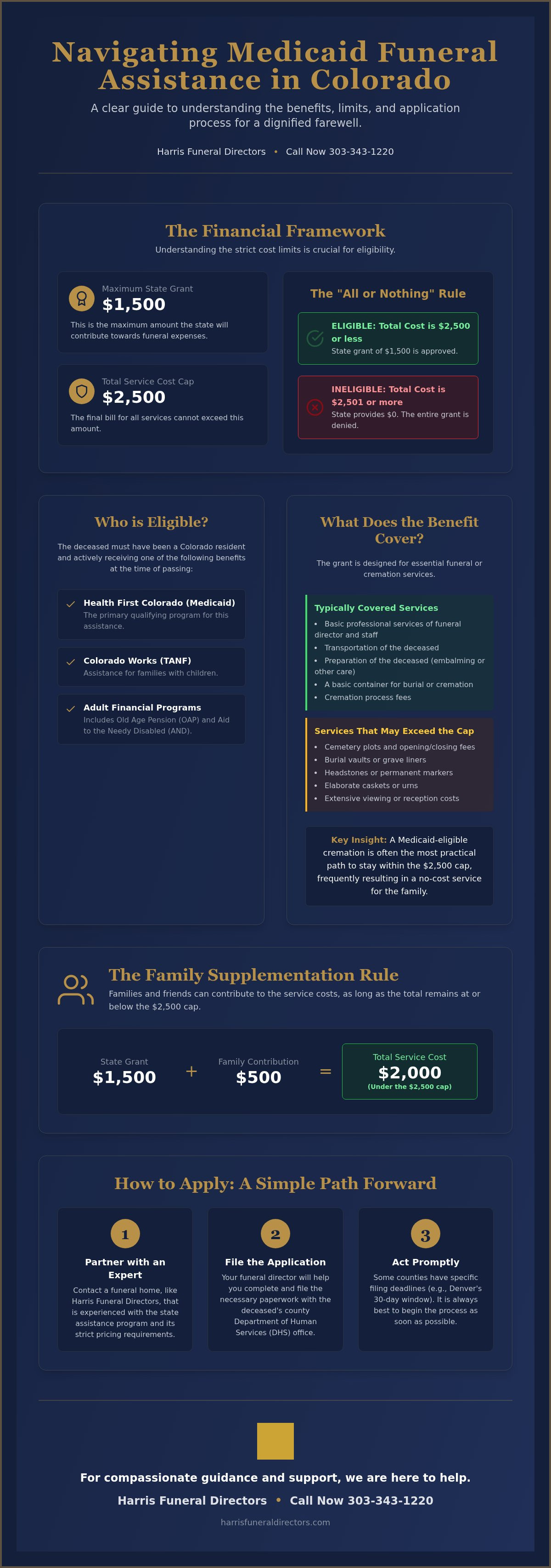
To qualify for Medicaid funeral assistance Colorado, the deceased must have been a resident of the state and actively receiving certain benefits at the time of their passing. This includes Health First Colorado (Medicaid), Colorado Works, or Adult Financial programs such as the Old Age Pension (OAP) or Aid to the Needy Disabled (AND). For 2026, the OAP grant standard is $1,032, while the AND-CS grant standard is $994. Previous enrollment in these programs simplifies the process, as the county already has the necessary financial records on file.
The state maintains very strict financial boundaries for this assistance. The maximum grant available is $1,500. However, the total cost of all funeral or cremation services cannot exceed $2,500. If the total bill is even slightly over this limit, the state will deny the entire grant. This makes choosing an affordable provider essential to staying within the program's guidelines.
The Role of the County DHS Office
Your specific county of residence, whether it's Adams, Arapahoe, or Denver, plays a central role in your claim. While the state sets the overarching rules, the local Department of Human Services (DHS) office processes the application and manages the specific funding pool for its residents. Some counties may have specific deadlines for filing, such as Denver's 30-day window, so acting quickly is often helpful. A public assistance funeral is a dignity-focused benefit for eligible residents that provides essential services through a partnership between the state and local providers. Understanding these local nuances is part of how we guide families through this difficult time with clarity and honesty.
What Does the Colorado Funeral Benefit Actually Cover?
Understanding the financial boundaries of state support helps you plan a service that is both meaningful and manageable. The core of the benefit covers essential professional services, such as the preparation of the deceased, transportation from the place of passing, and a basic container for burial or cremation. According to Colorado's Burial Assistance Program, the state provides a maximum grant of $1,500 to help offset these costs. This funding is designed to ensure that every resident, regardless of their financial situation, can be laid to rest with respect.
There is a vital rule to remember when applying for Medicaid funeral assistance Colorado provides. The total cost of the funeral or cremation services cannot exceed $2,500. If the final bill goes even one dollar over this threshold, the state will not provide any funding at all. This "all or nothing" approach makes it essential to work with a provider who understands how to build a service that stays within these strict limits. Staying within these boundaries ensures that the financial support remains available to your family during a time of need.
Medicaid Burial Assistance vs. No-Cost Cremation
While burial is a traditional choice, it often carries costs that exceed the $2,500 threshold once you include cemetery plots, vault requirements, and headstones. Because these items often require separate funding, many families find that a Medicaid-eligible cremation service is the most practical path. This option typically covers the entire process within the grant amount, often resulting in a no-cost service for the family. It allows you to focus on the emotional aspects of remembrance rather than worrying about a growing balance of expenses.
Understanding the Supplementation Rule
The state's program is designed to be a partnership. The supplementation rule allows families to contribute their own funds to enhance the service, provided the total cost remains at or below $2,500. For example, if a service costs $2,000, the state provides the $1,500 grant, and the family can pay the remaining $500. Looking at transparent pricing and packages helps you see exactly where those funds go, whether you want to add personalized memorial folders or a small floral arrangement. If you're unsure about how these limits apply to your situation, reviewing our services overview can provide a clearer picture of your options.
How to Apply for Medicaid Funeral Assistance in Colorado
Applying for financial support during a time of loss can feel like a heavy burden, but the process is manageable when you have a clear path to follow. The first step is to contact a funeral home that actively works with state programs. Not every provider is willing to accept the specific price caps required for eligibility, so finding a partner who understands these rules is vital. At Harris Funeral Directors, we act as your advocate, helping you gather the necessary details while we handle the formal coordination with the state.
Once you've selected a provider, the focus shifts to your local county human services department. While the state provides the framework, it's the county office that reviews the deceased's assets and approves the funding. Your funeral director will typically submit the required state forms on your behalf, but they will need your help to collect personal documentation. This collaborative approach ensures that the application is accurate and reflects the true financial need of the family, which is essential for securing Medicaid funeral assistance Colorado benefits.
Required Documentation Checklist
To keep the process moving steadily, it helps to have certain records ready for your funeral director. These documents prove that the deceased met the residency and financial requirements for the program. Having these items on hand can prevent delays that might otherwise complicate the arrangements.
- Proof of Status: Documentation showing the deceased was receiving Health First Colorado, SSI, or an Adult Financial program benefit.
- Identification: The Social Security number and proof of Colorado residency for the deceased.
- Financial Statements: A list of assets, including any bank account balances or life insurance policies.
- Service Details: An itemized statement of the funeral or cremation costs provided by the funeral home.
- Verification of Death: A copy of the death certificate or a formal proof of death from a medical professional.
Timing and Deadlines
Timing is critical when you're seeking assistance. While there isn't one single deadline that applies to every corner of the state, many local offices, such as the Denver Department of Human Services, strictly enforce a 30-day window from the date of death. If you wait too long to start the application, you risk losing the benefit entirely. It's also important to apply before the services are fully paid for, as the program is designed to assist those who don't have the immediate funds available.
Because these windows are so tight, we specialize in helping families with immediate need arrangements. We work quickly to ensure all paperwork is filed before any deadlines pass. This proactive support allows you to focus on your family's emotional needs while we manage the logistical hurdles of the state's application process.
Choosing a Medicaid-Friendly Funeral Home in Aurora
Finding a partner who accepts Medicaid funeral assistance Colorado can sometimes be a challenge. Many large corporate funeral chains decline these cases because the state's reimbursement rates don't align with their high overhead costs. This can leave families feeling stranded during an already difficult time. It's essential to find a provider who views this service as a community mission rather than just a transaction. You deserve a "Compassionate Guide" who understands the nuances of the paperwork and treats your family with the same care as any other.
When you call a local home, be direct with your questions. Ask if they offer no-cost cremation for Medicaid recipients. A transparent provider will be honest about what's included and how they work within the $2,500 total cost cap. They should be able to explain how the $1,500 grant covers their professional services without making you feel like a burden. Evaluating the dignity and quality of service is just as important as the funding source itself. A respectful farewell isn't defined by the price tag, but by the attention to detail and the kindness shown to the family.
Why Family-Owned Providers Often Offer More Personal Care
There's a distinct difference between a local firm and a corporate-owned facility. Large chains often have rigid sales quotas that make it difficult for them to accommodate state-funded programs. In contrast, Harris Funeral Directors is family-owned and operated right here in Aurora. We prioritize community service over profit margins, ensuring that our neighbors have access to a dignified farewell regardless of their financial situation. Having a partner who knows the specific systems in Arapahoe and Denver counties can save you hours of frustration and administrative delays.
Addressing the "Low Quality" Myth
A common fear is that a state-funded service will feel "cheap" or rushed. This shouldn't be the case. A professional provider uses their professional service fees to maintain high standards of care for every person they serve. Whether it's a traditional burial or a simple cremation, the focus remains on honor and remembrance. Financial status never dictates the level of respect a loved one receives. Every family deserves a peaceful environment to say their final goodbyes. We believe that quality care is a right, not a luxury reserved for those with high budgets.
If you're ready to discuss how we can help your family stay within state guidelines while providing a beautiful tribute, reach out to our compassionate team for immediate assistance.
Harris Funeral Directors: Your Partner in Medicaid Coordination
When you are facing the loss of a loved one, the last thing you should have to worry about is the complexity of state bureaucracy. At Harris Funeral Directors, we see ourselves as more than just a service provider; we are your steady partner during one of life's most challenging moments. Our family-owned business is built on a foundation of trust and transparency. We are committed to providing dignified services to every family in Aurora, regardless of their financial circumstances. By specializing in Medicaid funeral assistance Colorado programs, we ensure that no family is left to navigate these difficult decisions alone.
Our Medicaid no-cost cremation assistance program is specifically designed to work within the state's strict financial guidelines. We understand that the $2,500 total cost cap is a firm limit, and we've structured our services to provide a respectful, professional farewell that stays within those boundaries. We take the lead on the administrative side, coordinating directly with the county offices to manage the necessary paperwork. This allows you to step back from the logistics and focus on your family's emotional needs and the process of grieving. We also provide specialized support for veteran families who may be eligible for dual benefits, such as the Social Security one-time death benefit of $255 alongside state assistance.
A Compassionate Guide Through the Process
We believe in a family-to-family approach to planning. When you sit down with us, you aren't just a client; you're a neighbor who deserves our full attention and empathy. Our role as a "Compassionate Guide" means we walk beside you, explaining every option with clarity and patience. Beyond the immediate arrangements, we offer resources for grief support and emotional healing to help your family find a path forward. Starting the process is as simple as a phone call, and we'll take it from there with the care your loved one deserves.
Serving Aurora, Denver, and the Surrounding Metro Area
Our deep roots in the Aurora community give us a unique perspective on the needs of local residents. We've spent years building relationships with the human services departments in Arapahoe, Adams, and Denver counties, which helps us move your application through the system efficiently. If you have questions about what is included in your specific situation, we invite you to schedule a consultation regarding Medicaid funeral benefits. We're here to provide the answers and stability you need. You can find our contact information here for 24/7 assistance, ensuring that whenever you need us, our family is ready to support yours.
Honoring Your Loved One with Confidence and Peace
Navigating the path of loss is never easy, but you don't have to walk it alone. By understanding the strict financial limits and the importance of acting within the 30-day county deadline, you can secure the support your family deserves. It's vital to remember that Medicaid funeral assistance Colorado programs are designed to protect the dignity of your loved one while easing the financial pressure on those left behind. Working with a partner who understands the specific requirements of Arapahoe, Denver, and Adams counties makes all the difference in a successful claim.
As a family-owned Aurora tradition, we specialize in Medicaid no-cost cremation assistance and provide expert guidance on Colorado county DHS requirements. We're here to handle the complex paperwork so you can focus on healing and remembrance. Contact Harris Funeral Directors for assistance with Medicaid funeral arrangements. You have the strength to navigate this journey, and we're honored to be by your side every step of the way.
Frequently Asked Questions
Does Medicaid cover the full cost of a funeral in Colorado?
No, the state program does not cover the entire cost of most services. Colorado provides a maximum burial assistance grant of $1,500, but there is a strict rule attached. The total cost of the funeral or cremation cannot exceed $2,500. If the final bill is higher than this limit, the state will not provide any funding at all. This makes choosing an affordable provider essential for your family.
How do I know if my loved one is eligible for Medicaid burial assistance?
Eligibility is based on the deceased person's status at the time of their passing. They must have been a Colorado resident receiving benefits from Health First Colorado, Colorado Works, or an Adult Financial program. These programs include the Old Age Pension and Aid to the Needy Disabled. We can help you verify these details to confirm if you qualify for Medicaid funeral assistance Colorado benefits.
Can I choose burial if Medicaid only covers cremation?
You can certainly choose a traditional burial, though it's more difficult to stay within the $2,500 total cost cap. While the state grant applies to both options, the additional costs of a casket and cemetery fees often push burial totals over the limit. If you prefer burial, we can help you explore our most affordable packages to see if they meet the state's strict financial requirements for the grant.
Which Colorado counties provide the best funeral assistance?
Every county in Colorado follows the same state guidelines regarding the $1,500 grant maximum. However, the experience can feel different depending on local processing times. Counties like Arapahoe, Adams, and Denver manage their own applications through their Human Services departments. We maintain strong relationships with these local offices to help ensure your claim is handled with the care and urgency your family deserves during this difficult time.
What happens if the deceased had a small life insurance policy?
The state views life insurance as an available asset that must be used toward funeral expenses first. The burial assistance program is designed as a "payer of last resort." This means the state only contributes if the deceased's total assets, including insurance and bank accounts, are less than the cost of the service. If a policy exists, it may reduce the amount of the grant you receive from the county.
Is there a time limit to apply for Medicaid funeral benefits in Colorado?
Yes, you must act quickly because deadlines are set at the county level and can be very short. For instance, Denver County generally requires applications to be filed within 30 days of the date of death. If you miss this window, the county may deny the claim entirely. We recommend starting the application process as soon as possible to ensure you don't lose access to these helpful state funds.
Can I pre-plan a Medicaid funeral in Aurora?
You can certainly record your wishes and select an affordable service level in advance. However, the state only performs the final eligibility check after a person has passed away. Pre-planning is still a wise choice because it ensures your family knows which services fit within the Medicaid funeral assistance Colorado price caps. This preparation removes the burden of making difficult financial decisions during the first few days of grief.
What if the county denies my application for assistance?
If your application is denied, the county will provide a reason, such as the total cost exceeding $2,500 or the discovery of disqualifying assets. You have the right to review this decision and provide additional documentation if there was a simple clerical error. We can assist you in reviewing the itemized statement and the county's response to see if an appeal or a correction is possible for your situation.


