

Harris Funeral Directors
Call Now 303-343-1220
What financial support may be available after your spouse passes away? Social security death benefits for spouse may include monthly survivor benefits, but the rules can feel difficult to sort through while you’re grieving and handling paperwork. It’s understandable to worry about household income and wonder whether Social Security can help with funeral expenses.
This guide explains who may qualify for monthly payments and how the one-time $255 lump-sum death payment works. You’ll also find practical information about applying and the difference between these forms of support, so you can take the next steps with greater clarity and less uncertainty.
Harris Funeral Directors
Call Now 303-343-1220
Understanding Social Security Death Benefits for Spouse
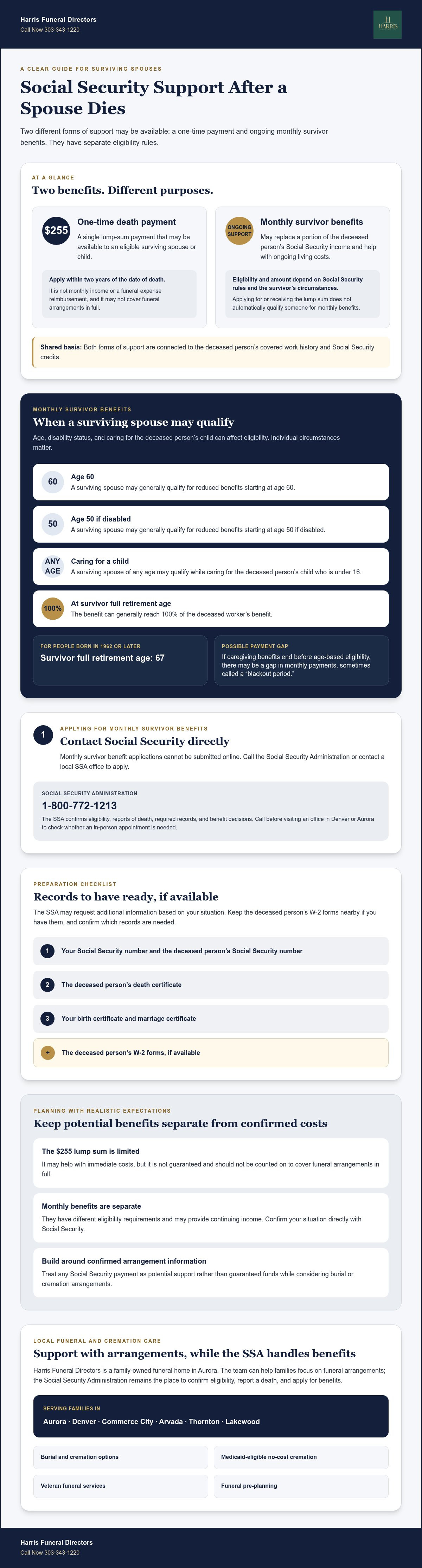
After a spouse dies, Social Security may offer two different forms of financial support: a one-time payment and, for eligible survivors, ongoing monthly benefits. Knowing how they differ can make the next steps feel more manageable.
The lump-sum death payment is a one-time $255 payment that may be available to an eligible surviving spouse or child. It isn’t monthly income or a reimbursement specifically reserved for funeral expenses. If received, it may help with immediate costs, but it is modest and should not be counted on to cover funeral arrangements in full.
Monthly survivor benefits serve a different purpose. They can replace a portion of the deceased person’s Social Security income and help support a survivor’s ongoing living costs. The amount and eligibility depend on Social Security’s rules and the survivor’s circumstances.
The Difference Between Lump-Sum and Monthly Survivor Benefits
Think of the $255 payment as a single benefit, while monthly survivor benefits may provide continuing income. The lump-sum payment must be applied for within two years of the date of death. Applying for or receiving it does not mean a surviving spouse automatically qualifies for monthly benefits. Those are considered separately.
Both forms of support are connected to the deceased person’s work history. Social Security credits are earned through covered work, and those credits help determine whether family members may qualify for benefits. Since the exact eligibility rules can vary, check your situation directly with the Social Security Administration rather than assuming that one payment guarantees the other.
Understanding these distinctions can help families plan with clearer expectations while making arrangements for a burial or cremation. Social security death benefits for spouse may provide support, but the lump sum is limited and monthly benefits have separate eligibility requirements.
Eligibility Requirements and How to Apply
Eligibility for monthly survivor benefits depends on your age, disability status, and whether you’re caring for the deceased person’s child. A surviving spouse may generally qualify for reduced benefits starting at age 60, or at age 50 if disabled. At survivor full retirement age, the benefit can generally reach 100% of the deceased worker’s benefit. For people born in 1962 or later, survivor full retirement age is 67.
A surviving spouse of any age may qualify for benefits while caring for the deceased person’s child who is under 16. If that caregiving benefit ends before the spouse qualifies based on age, there may be a gap in monthly payments, sometimes called a “blackout period.” Individual circumstances matter, so confirm eligibility with Social Security.
Applications for monthly survivor benefits can’t be submitted online. Call the Social Security Administration at 1-800-772-1213 or contact a local SSA office to apply. The rules for social security death benefits for spouse can be difficult to sort through, but gathering key records first may make the process more manageable.
Essential Documentation for Your Social Security Claim
Have these documents or details ready if available. The SSA may request additional information based on your situation:
- Your Social Security number and the deceased person’s Social Security number
- The deceased person’s death certificate
- Your birth certificate and marriage certificate
Keep the deceased person’s W-2 forms nearby if you have them, but confirm with the SSA which records are needed for your claim. Application steps can vary, so call before visiting an office in Denver or Aurora to check whether an in-person appointment is needed. For funeral and cremation options, you can also learn more about Harris Funeral Directors.
How Harris Funeral Directors Supports Your Benefit Claims
After a loss, arranging a funeral while sorting through benefit questions can feel like a great deal to manage. Harris Funeral Directors is a family-owned funeral home in Aurora, serving families in Aurora, Denver, Commerce City, Arvada, Thornton, and Lakewood. Our team can help you focus on funeral arrangements, while the Social Security Administration remains the place to confirm eligibility, report a death, and apply for benefits.
The one-time $255 payment may be available to an eligible survivor, but it isn’t guaranteed to cover funeral expenses. Keep it separate from confirmed arrangement costs when planning. Harris Funeral Directors offers burial and cremation options. For questions about the application or required documents for social security death benefits for spouse, contact the SSA directly. Harris also assists families exploring Medicaid-eligible no-cost cremation and provides veteran funeral services.
Planning ahead can give families time to record their wishes and consider how arrangements may fit into future plans. It can also help loved ones understand those wishes during a difficult time. Learn more about funeral pre-planning services. Social security death benefits for spouse may be one part of a family’s financial planning, but the SSA determines eligibility and payment decisions.
Integrating Benefits with Funeral Planning in Aurora
Build a practical budget around confirmed arrangement information, and treat any Social Security payment as potential support rather than guaranteed funds. Monthly survivor benefits and the lump-sum payment have different eligibility rules. Harris Funeral Directors serves families in Aurora and the surrounding communities of Denver, Commerce City, Arvada, Thornton, and Lakewood with burial and cremation services as families consider arrangements and manage practical steps.
Harris Funeral Directors
Call Now 303-343-1220
Take the Next Step With Clarity and Support
Understanding the difference between a one-time payment and monthly survivor benefits can help you plan with realistic expectations. Eligibility depends on your circumstances, and the Social Security Administration handles benefit applications and decisions. Contact the SSA directly to confirm what support may be available to you.
As you make arrangements, you don’t have to manage every practical detail alone. Harris Funeral Directors is a family-owned Aurora funeral home offering personalized care, burial and cremation services, and assistance for families exploring Medicaid-eligible cremation or veteran funeral services. Social security death benefits for spouse may be one part of your planning, alongside the arrangements that feel right for your family.
Take each step at your own pace. Support and clear information can help you make decisions with greater confidence.
Harris Funeral Directors
Call Now 303-343-1220
Frequently Asked Questions
How do I notify Social Security of a death?
Call the Social Security Administration at 1-800-772-1213 or contact a local SSA office to confirm the death has been reported and ask about applying for benefits. In many cases, a funeral home reports the death, but it’s still wise to check with the SSA. Survivor benefit applications can’t be completed online, so ask the agency what steps and documents apply to your situation.
Can a divorced spouse claim survivor benefits?
Yes, a surviving divorced spouse may qualify if the marriage lasted at least 10 years and they meet Social Security’s other requirements. Generally, they must be at least 60, or 50 if disabled, and unmarried. Remarriage after age 60, or after age 50 if disabled, may not prevent eligibility. Contact the SSA to confirm how your circumstances affect a claim.
How long does it take to receive the $255 death benefit?
There isn’t a processing timeline confirmed here, so contact the SSA for an estimate based on your application. The one-time $255 lump-sum death payment must be applied for within two years of the date of death. It’s separate from monthly survivor benefits, and the SSA determines eligibility and processes the claim. Ask whether any additional records are needed when you apply.


