

You are likely standing in a moment of stillness while the world around you continues to move, feeling the heavy weight of a recent loss. In these first few hours, the pressure to act can be just as intense as the grief itself. Understanding exactly what to do when someone dies in Colorado is a vital first step, yet the legal requirements and logistical choices often feel like a mountain you aren't prepared to climb. You want to honor your loved one with dignity, but the fear of missing a deadline or making a wrong decision can be paralyzing.
It's natural to feel anxious about things like funeral costs, Medicaid eligibility, or who is legally allowed to make final arrangements. This guide serves as your compassionate advocate, offering a clear roadmap through the requirements following a loss in our state. We will cover the essential first 48 hours, explain how to handle Colorado's 2026 legal updates, and provide the clarity you need to move forward. By the end of this article, you'll have a steady plan to manage the practical details so you can focus on what truly matters: remembrance and healing.
First Steps After a Death in Colorado
When you are faced with the immediate reality of loss, your first instinct might be to rush. However, the most important thing you can do in these first few minutes is to pause. Knowing what to do when someone dies in Colorado begins with identifying where you are and who needs to be notified first. A medical professional must officially determine the legal definition of death before any transport or arrangements can begin. This pronouncement is the foundation for the death certificate and all subsequent legal steps. Taking a breath before making major financial commitments allows you to move forward with a clearer mind.
If the Death Occurs at Home or Unexpectedly
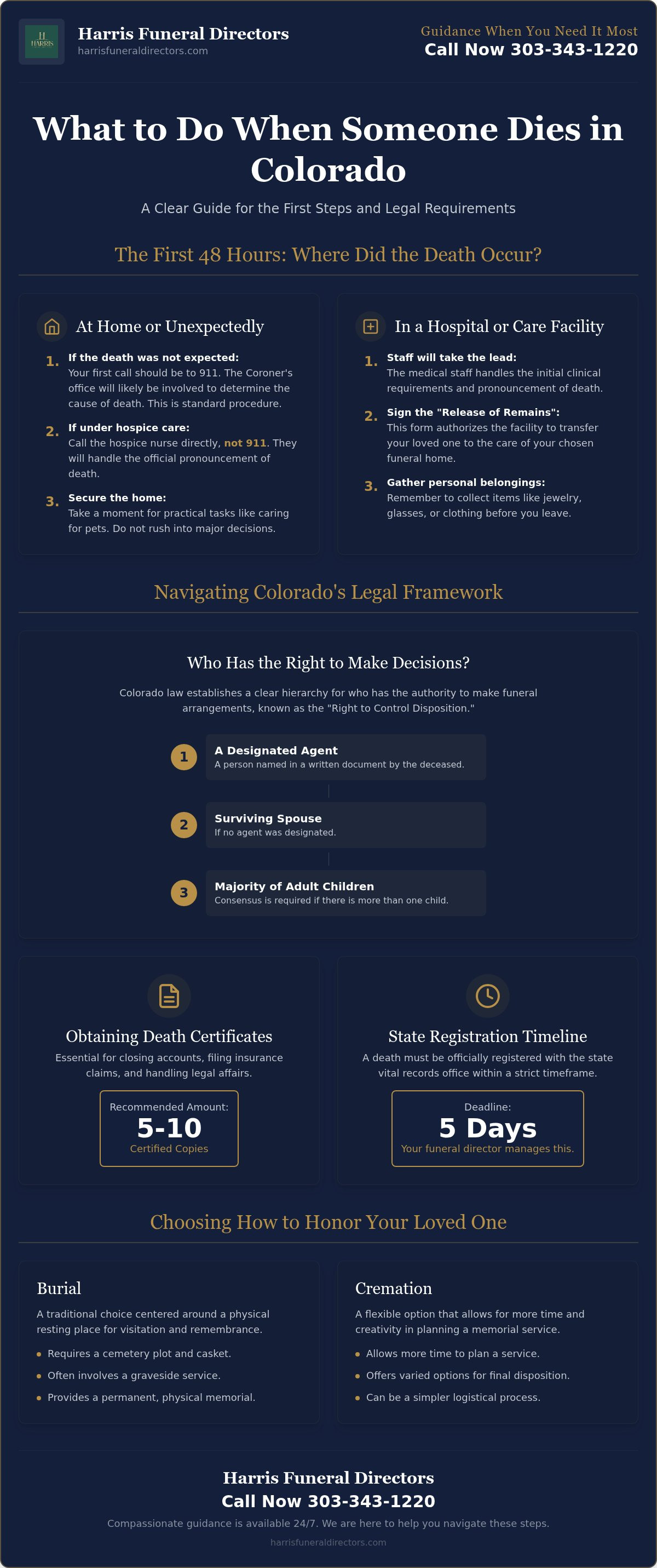
If a death happens at home and was not expected, your first call should be to 911. In counties like Arapahoe or Adams, the Coroner's office will likely become involved to determine the cause of death. This is a standard procedure and does not mean anything is wrong; it is simply part of the local legal requirement for unexpected passing. If your loved one was under hospice care, call the hospice nurse instead of emergency services. They will handle the formal pronouncement and guide you on the next steps. While you wait for officials to arrive, take a moment to secure the home and ensure any pets are fed and cared for. These small, practical acts can provide a gentle sense of purpose during a chaotic hour.
If the Death Occurs in a Hospital or Care Facility
In a hospital, nursing home, or assisted living facility, the staff will take the lead on the initial clinical requirements. They will typically ask you which funeral home you have chosen to handle the arrangements. You'll need to sign a "Release of Remains" form, which gives the facility permission to transfer your loved one into the professional care of a funeral director. It is helpful to begin the Immediate Need process early so that transportation can be coordinated smoothly between the facility and the funeral home. Remember to gather personal belongings like jewelry, glasses, or clothing before you leave the building. There's no need to feel pressured into making permanent decisions immediately. Your priority is simply ensuring your loved one is safely cared for and the legal pronouncement is correctly recorded.
Understanding Colorado's Legal Requirements and Decision-Making Rights
The legal side of loss often feels cold, but these laws exist to protect your loved one's dignity and your family's peace of mind. In Colorado, the "Right to Control Disposition" is a specific legal framework that dictates who has the authority to make funeral arrangements. This isn't just a matter of tradition; it's governed by Colorado Revised Statutes. When you are determining what to do when someone dies in Colorado, identifying the legal decision-maker is a priority. Usually, this follows a clear hierarchy: a person designated in a written document, followed by a surviving spouse, and then a majority of surviving adult children. If children disagree on the path forward, the law typically requires a majority consensus before a funeral director can proceed with burial or cremation.
Colorado law also sets a strict timeline for administrative duties. A death must be registered with the local or state vital records office within five days. While this sounds like a daunting task, your funeral director acts as your advocate, coordinating with doctors and the state to ensure every document is filed correctly and on time. This professional oversight helps prevent legal delays that could otherwise complicate the grieving process.
Who Has the Legal Authority to Plan the Funeral?
The most straightforward scenario occurs when the decedent has left a "Designated Beneficiary Agreement" or a written declaration naming a specific agent. This document overrides the standard family hierarchy. If no such document exists, the responsibility falls to the next-of-kin. In cases where the legal next-of-kin is unavailable or unwilling to act, the responsibility may shift to more distant relatives or even a court-appointed representative. For a deeper look at these complex legal layers, the Colorado Bar Association's guide provides extensive details on probate and estate laws that may apply to your situation.
Obtaining and Using Death Certificates
You will quickly find that death certificates are the primary key for closing bank accounts, filing insurance claims, and starting the probate process. Most families in the Denver-Aurora area find that ordering 5 to 10 certified copies is necessary to handle various financial and legal institutions. These are ordered through the Colorado Department of Public Health and Environment (CDPHE), and your funeral director will typically handle this request for you during the initial arrangement conference. To help your family avoid these legal hurdles in the future, you might consider how to plan ahead by documenting your own final wishes today.
Choosing Between Burial and Cremation in the Denver-Aurora Area
Once the initial legal requirements are addressed, the focus shifts toward honoring your loved one's unique legacy. This is often the most personal part of deciding what to do when someone dies in Colorado. Choosing between burial and cremation involves balancing family traditions, personal wishes, and practical logistics. While some families find comfort in the permanent, physical presence of a gravesite, others prefer the flexibility and simplicity that cremation provides. The Colorado Bar Association's guide offers a helpful framework for these practical matters, ensuring you don't overlook any essential steps during this decision-making process.
Logistically, an immediate burial requires a cemetery plot and a casket, often involving a graveside ceremony within a few days of the passing. Direct cremation, on the other hand, allows for more time to plan a memorial service later. In the Greater Denver area, families have access to several beautiful cemeteries, each with its own requirements and atmosphere. Reviewing transparent pricing and packages early in the process helps you understand your options without the pressure of unexpected expenses. This clarity allows you to focus on creating a meaningful farewell that truly reflects the life being celebrated.
Traditional Burial and Veteran Services
A traditional burial often includes a viewing or visitation, a formal service at a funeral home or church, and a final committal at the cemetery. These components provide a structured way for the community to offer support and say goodbye. For families of those who served, Veteran Funeral Services at Fort Logan National Cemetery offer a powerful way to recognize a life of service with full military honors. You can find more detailed guidance on these options in our sibling article, Traditional Burial Services in Aurora: A Compassionate Guide for Families.
Medicaid and No-Cost Cremation Options
We understand that financial concerns can add a significant layer of stress during a time of grief. In Colorado, Medicaid offers burial assistance for families who meet specific eligibility requirements. In some cases, this can result in a no-cost cremation for residents in Aurora and Denver who have limited financial resources. This program is designed to ensure that every individual is treated with dignity, regardless of their financial situation. To learn more about qualifying for these benefits, please refer to our guide on Medicaid Cremation in Aurora: A Buying Guide to No-Cost Services.
Practical Logistics: A Notification Checklist for Families
The period following a loss is often filled with a dizzying array of administrative tasks. While your focus is naturally on remembrance, knowing what to do when someone dies in Colorado includes managing a series of practical notifications. One of the first steps is informing the Social Security Administration. In most cases, your funeral director will handle this initial report for you. This helps prevent benefit overpayments and simplifies the process for surviving spouses. You should also contact life insurance companies early to start the claim process. These funds are often vital for covering immediate expenses and providing long-term stability for your family.
Managing a digital legacy has become a significant part of modern estate handling. You'll need to decide how to handle social media profiles and email accounts. Some platforms allow you to memorialize an account, while others require specific legal documentation to close them entirely. Additionally, don't forget to visit the Post Office to forward mail. This simple step protects against identity theft and ensures that you don't miss important legal or financial correspondence during this transition. Taking these steps early creates a supportive framework that prevents administrative burdens from piling up.
Financial and Government Notifications
Preventing identity theft is a practical necessity during a time of grief. You should notify banks and credit card companies as soon as possible to freeze accounts and prevent unauthorized charges. If your loved one was a veteran, it's essential to contact the Department of Veterans Affairs (VA) to stop benefit payments and inquire about potential burial honors. For those navigating the complexities of funding, our sibling article on Using Life Insurance for Funeral Expenses in Colorado: A Compassionate Guide provides detailed steps for managing these specific claims.
Household and Utility Management
If the decedent's home will be vacant, you must secure the property and manage the ongoing utilities. Contact providers like Xcel Energy, as well as local water and trash services, to either stop service or transfer the billing to the estate. Review bank statements to identify recurring subscriptions like gym memberships, streaming services, or magazine deliveries. Taking these steps early prevents the accumulation of unnecessary debt and ensures the home remains safe. If you find the logistical burden too heavy to carry alone, our team is here to provide personal services and guidance tailored to your family's needs.
Honoring Their Legacy: Obituaries and Memorial Services
Once the legal timelines are met and the initial logistics are settled, your focus naturally shifts toward the heart of the matter: the person you loved. This final stage of what to do when someone dies in Colorado is about more than just checking off a list. It is about crafting a tribute that reflects a unique life and provides a space for the community to gather in support. Whether you choose a formal funeral or a more casual celebration of life, this moment serves as a vital step in the healing journey for those left behind. Taking the time to gather stories, favorite memories, and significant life facts helps ensure the service feels personal and sincere.
The obituary plays a dual role in this process. It acts as both a formal notification to the public and a celebration of a life well-lived. In our modern world, online obituaries have become a powerful tool for sharing these stories with distant family and friends. These digital spaces allow people from across the country to share condolences, post photos, and feel connected to the service even if they cannot attend in person. By blending traditional elements with these accessible platforms, you create a lasting record of your loved one's legacy that can be revisited for years to come.
Writing a Meaningful Obituary
A well-written obituary provides clarity and comfort. It should include essential details such as full name, dates of birth and passing, and a list of surviving family members. Beyond the facts, it is a space to mention memorial donations or "in lieu of flowers" requests, which can guide the community's desire to help toward a cause that was close to your loved one's heart. For more detailed advice on crafting these messages, you can refer to our guide on Obituary Notification Services in Aurora: A Compassionate Guide for Families.
Planning the Service with Harris Funeral Directors
Personalizing a ceremony is what makes it truly memorable. We encourage you to bring in music, photos, and unique tributes that speak to the individual's passions and personality. Choosing a family-owned funeral home ensures that you receive a personal touch during this planning process, as we treat every family like our own. Many people find that pre-planning their own arrangements is a profound gift to their survivors, as it removes the burden of making difficult decisions during a time of intense grief. This foresight allows families to focus entirely on honoring the memory of their loved one with dignity and peace.
Moving Forward with Support and Dignity
Navigating the first few days after a loss requires a steady hand and a clear heart. From understanding the legal hierarchy of decision-making to choosing between a traditional burial or a personalized cremation, you now have a roadmap for the path ahead. Knowing exactly what to do when someone dies in Colorado helps transform an overwhelming experience into a series of manageable, respectful steps. By focusing on the essential notifications and the creation of a meaningful legacy, you ensure your loved one is honored with the dignity they deserve.
You don't have to walk this path alone. If you have an immediate need, contact our compassionate team at Harris Funeral Directors today. As a family-owned and operated independent funeral home, we specialize in Medicaid and Veteran benefits, serving families in Aurora and Denver with sincerity and care. We are here to act as your trusted guide, offering the stability and transparency you need during this difficult time. Take comfort in knowing that with the right support, you can focus on healing and remembrance while we handle the practical details for you.
Frequently Asked Questions
How do I get a death certificate in Colorado?
Your funeral director typically handles the process of ordering death certificates through the Colorado Department of Public Health and Environment during the initial arrangement conference. As of January 1, 2026, the fee for a death certificate is $25.00 for the first copy and $20.00 for each additional copy ordered at the same time. These certified documents are essential for closing bank accounts and beginning the probate process.
Who is responsible for paying for the funeral if there is no money?
The legal responsibility for funeral costs typically falls to the decedent's estate first; if the estate is insolvent, the person who signs the service contract becomes responsible. However, Colorado Medicaid offers burial assistance for families who meet specific eligibility requirements, which can significantly reduce or eliminate the financial burden. We also provide affordable tiered pricing packages to help families find a respectful option within their means.
How long do I have to decide between burial and cremation in Colorado?
You generally have a window of a few days, as Colorado law requires a death to be registered with the local vital records office within five days. This registration must happen before the body is buried or cremated. While the timeline is relatively short, it's enough time to gather the family and consult with a funeral director to ensure the choice reflects your loved one's true wishes.
Does the state of Colorado pay for funerals?
The state doesn't provide a universal payment for funerals, but Colorado Medicaid offers specific burial and cremation assistance for residents who qualify based on financial need. This program ensures that every individual is treated with dignity regardless of their financial situation. Our team is experienced in navigating these state benefits and can help you determine if your loved one is eligible for this assistance.
What happens if someone dies at home in Aurora?
If a death occurs at home in Aurora and was unexpected, you must call 911 so the Arapahoe or Adams County Coroner can be notified to determine the cause of death. If the person was already under hospice care, you should call the hospice nurse instead of emergency services. Once the medical professional makes the official pronouncement, you can then contact a funeral home to coordinate the transfer of your loved one.
How do I notify Social Security about a death?
You don't usually need to contact Social Security yourself; the funeral home will send an official notification to the Social Security Administration as part of their professional services. This is a standard part of what to do when someone dies in Colorado and helps prevent benefit overpayments. This notification also allows a surviving spouse to begin the application process for any applicable survivor benefits or the one-time death payment.
Can I handle the funeral arrangements myself without a funeral home in Colorado?
While Colorado does allow for home funerals, the legal requirements for filing death certificates and obtaining transit permits are quite complex for a grieving family to manage alone. Partnering with a professional funeral home ensures that every 2026 legal requirement is met accurately and within the five-day registration window. This professional oversight provides a safety net, allowing you to focus on your family's emotional needs rather than administrative paperwork.
What is the 'Right to Control Disposition'?
The "Right to Control Disposition" is a legal hierarchy under Colorado Revised Statutes that dictates who has the authority to make final arrangements. The order of priority starts with a person named in a written declaration, followed by a surviving spouse, and then a majority of surviving adult children. This law is designed to provide clarity and prevent family disputes by establishing a clear chain of command for all funeral and burial decisions.


